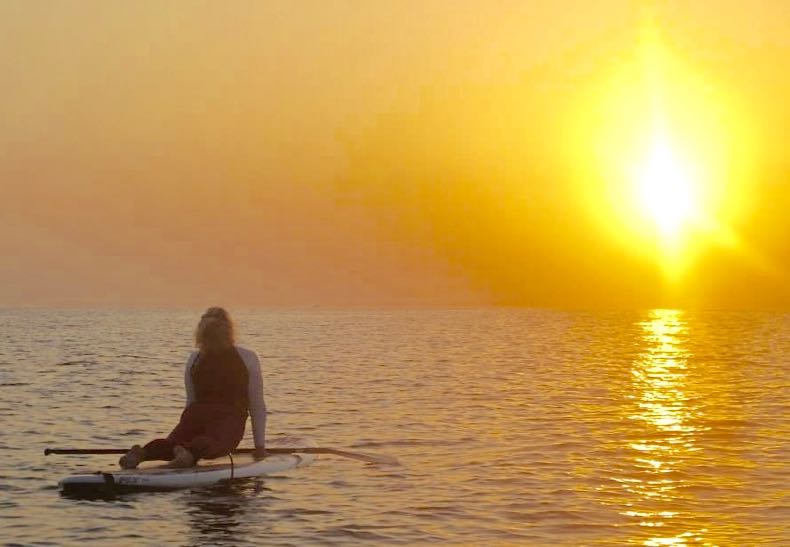
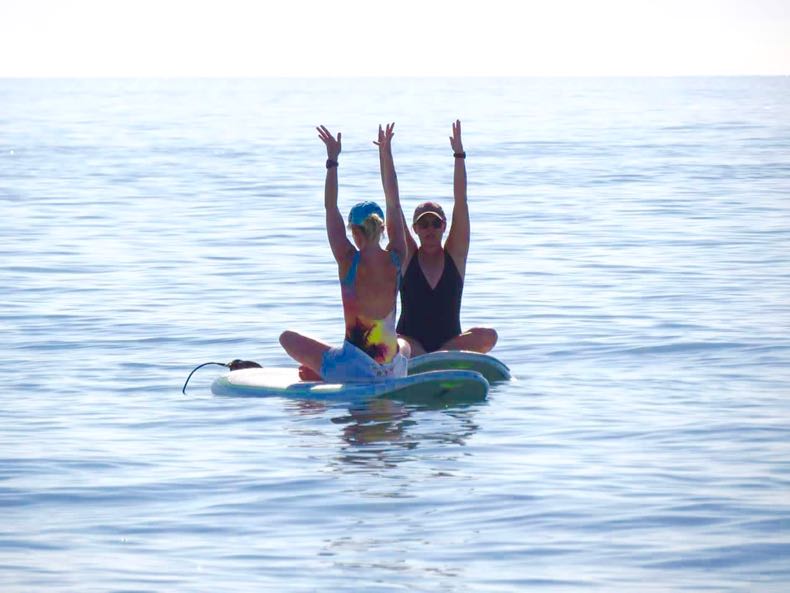
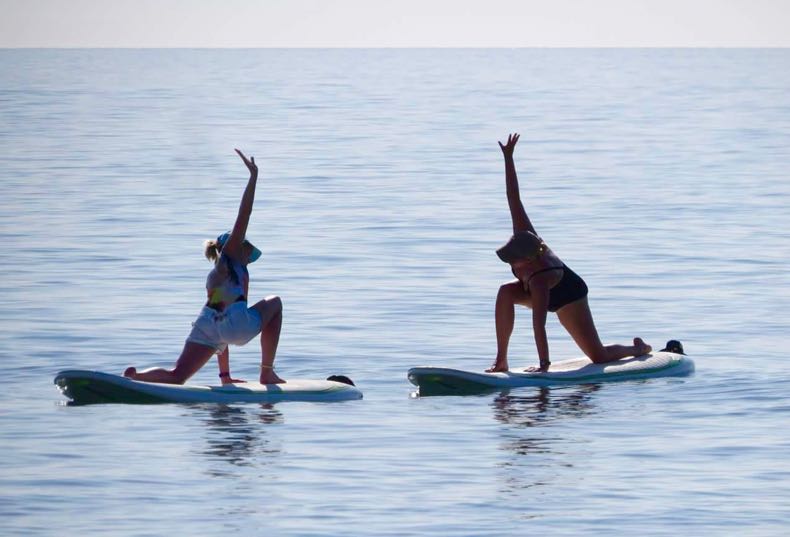
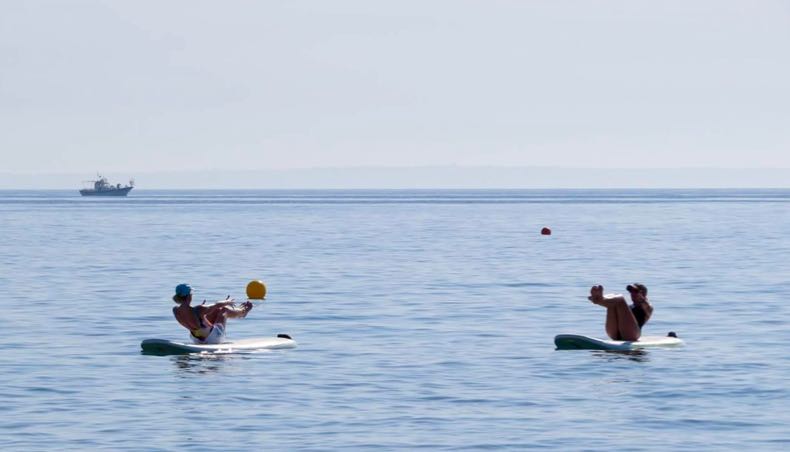
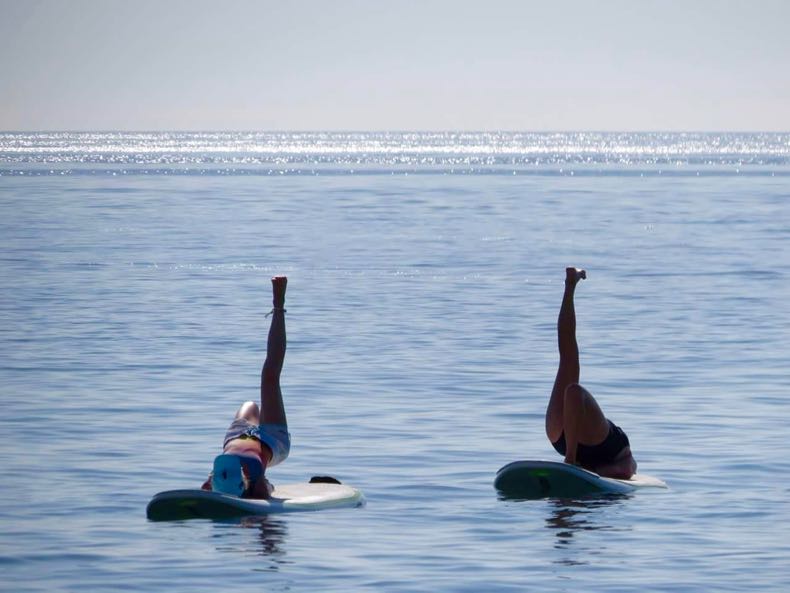
Cyprus is the perfect place for weddings, wind(surfing), occasionally waves AND for SUP Yoga! I am currently on the Island for all of the above and will be teaching two more SUP Yoga classes this Saturday and Sunday at WindsurfCity Cyprus in Makenzy Beach, Larnaca.
So what happens on a SUP Yoga class?
In all honestly I prefer calling SUP Yoga as “yoga inspired” class rather than a “yoga class.” As the whole thing happens whilst floating on what essentially is a big surf board (just wider and longer) it is simply impossible to have as good balance as we would standing on the ground. Therefore all the poses we do need to be more or less adapted and some are simply out of the question. Sure we can go to Instagram and see people doing headstands and all that stuff on a board but just like the other fancy poses you see, they do not represent the reality.
If you feel slightly disappointed now, don’t! SUP Yoga will challenged you regardless, even if you are experienced yogi or have never tried yoga before, because of the Sea beneath us. The key is to let go all expectations and just focus on the moment – and trust me, a sudden movement of the sea, in the middle of calm, really brings you to the here and now. I usually start my classes lying down, tuning in and build the sequence up to hands and knees and eventually standing. There will be plenty of familiar poses to be experienced in a new way and you can also expect to feel and activate your muscles in a different way. Falling in also happens, it is part of the fun and a sure way of test where the Ego is. And of course there is Savasana at the end. Nothing better than Savanasa lying down on a board, in the beautiful East Med, under the morning sun!
Wear your swim gear (bikini, swimsuit, rash vest if you prefer complete sun protection, shorts…), sunscreen, sun glasses you don’t mind getting wet and maybe a cap or another type of hat. Just like in a regular yoga class, is always better if your gear does not have buckles, decoration, big buttons or anything metallic as we will be lying down both on our backs and belly and you do not want anything pressing against your body.
Please book your board in advance by dropping me or Margarita a text via this and this link – SUPping is very popular so we want to make sure everybody who shows up gets a board and nobody is left waiting because of no-shows and/or drop ins. The cost of the class is 18 euros and it will be in English (although I do speak very poor Greek too, occasionally.)
July in Cyprus has been insanely hot (as in, A LOT hotter than the average 36-37C degrees) and humid. I still keep my yoga classes going (with great attendance as well so big bravo for everybody showing great dedication) but I have slowed down the rhythm of them somewhat. Focus has been on breath, some more detailed yoga philosophy and anatomy conversation and revisiting the basic poses, really taking our time to explore them and what difference minor adjustments can do. When lying down makes you sweat there is no point to have a super strong practise.
The one exception to this is the SUP yoga sessions I have been guiding on early Sunday mornings. It is the best time for the practise as the sun is high yet and the sea is little bit cooler. I’ve had many people coming to try SUP yoga (or “yoga inspired SUP fitness class” as I like to call it) for the first time, some of them yoga teachers themselves. I always tell them that they should not expect the practise on the board to be anything similar to their mat sessions. There is always some movement and current going on in the sea, none of which you can really predict. Although the boards used for SUP yoga are stable, they are still boards on the water and balance can be hard to maintain. Therefore warriors and lunges are done with a wider stance and you definitely get to work and feel your muscles in a different way. The SUP practise is also a good test on the state of ego: falling into the water happens easily but it is also part of the fun, as long as you let it be fun. At least the water is clear and warm, and you are guaranteed to wake up if there was no time for coffee in the morning.
Below are some pictures from my SUP yoga sessions this summer and during previous years. All of them are taken by the crew at WindsurfCityCyprus. To catch the next class I teach follow my Facebook page.
Kyproksella on ollut viikon kestävä helleaalto. Toisin kuin Suomessa, sana ”helleaalto” ei Kyproksella yleensä ilahduta kovin monia, onhan heinäkuun keskilämpötila jo valmiiksi aivan riittävät 36-37C astetta. Tänä vuonna sää kuitenkin on kuumin sitten 30 vuoteen ja sisämaassa Nikosiassa mitattiin muutama päivä sitten 45C lämpötila. Rannikolla on pyöritty neljässäkymmenessä asteessa ja merivesi on noin 27C asteista. Kun suihkustakaan ei tule kylmää vettä ennen lokakuuta niin miten täällä sitten eletään kesäkuukaudet?
Ilmastoinnin ja tuulettimien avulla tietenkin! Kyproksen lomakuu on elokuu joten vielä heinäkuun ajan ainakin onnekkaat toimistotyöntekijät pääsevät nauttimaan viilennetyistä sisätiloista. Ilmastointilaitteista otetaankin täällä kaikki irti ja varmaan jokaisesta toimistosta löytyy joku jolla on villatakki päällä ja huivi kaulassa tämän takia. Myös ostoskeskukset ovat kesäisin hyvä paikka viettää aikaa ja Nikosiassa on avattu joitain virallisia rakennuksia päivisin ihmisille jotka kaipaavat viileää tilaa. Lapsia, vanhuksia ja heikkokuntoisia kehotetaan pysymään sisällä ja juomaan tietenkin mahdollisimman paljon vettä. Tästä huolimatta helteet ovat jo vaatineet täällä muutaman kuolonuhrin.
Jos ilmastoitua tilaa ei ole käytössä on muitakin vaihtoehtoja. Itse herään koiran aloitteesta joka aamu puoli kuuden aikoihin jolloin lämpötila on reippaasti alle kolmekymmentä. Noin kymmeneen asti ilma on suhteellisen miellyttävä ja tällöin on hyvä hoitaa lenkit, uinnit, puutarhatyöt, siivoukset ja kaikki älyllistä toimintaa vaativa tekeminen. Alkuiltapäivästä auringon paistaessa korkeimmillaan nukutaan päiväunet ja ulos voi taas uskaltautua viiden jälkeen. Illalla valvon yleensä normaalia myöhempään ja viimeistelen aamulta jääneitä hommia. Ymmärrykseni Etelä-Euroopan maiden siestaa kohti on parantunut huomattavasti täällä asuessani.
Joogatunnit hoidan tietenkin normaalisti mutta ilman ollessa kuumimmillaan pidän tuntien kulun rauhallisena. Pysymme asanoissa hieman pidempään, ja voimakkaimmat harjoitukset ovat kesätauolla kun jo pelkkä paikallaan makaaminen saa hien virtaamaan.
SUP joogalle kesä on hyvää aikaa, veden lämpötila ei pelota ketään ja useat turistit haluavat mielellään kokeilla lomalla joitain uutta mitä ei välttämättä ole kotimaassa tarjolla. Larnakassa tuulee aina jonkun verran joten sen ja auringonpaisteen takia SUP joogatunnit pidetään aamuisin. Tämä on ehdottomasti yksi parhaista tavoista aloittaa aamu!
Alla muutamia kuvia aiemmin tällä viikolla pitämältäni yksityistunnilta. Seuraava SUP jooga tunti pidetään Larnakassa WindsurfCityCyprus’sen luona tulevana sunnuntaina (9. heinäkuuta) kello 8. Jos olet maisemissa varaa paikkasi tämän linkin takaa ja tule mukaan joogaamaan veden päällä!
***Teksti suomeksi englannikielisen perässä *** Finnish text after the English one, hyperlinks to jump directly to the language you want coming up as soon as I get my head around the html***
In short, SUP yoga is yoga on a stand up paddle board, which in turn is not too different from a big surfboard. Over the years (the past four five to be exact) I have however noticed that whilst there is a lot of curiousity when it comes to SUP yoga, a lot of people are not really sure what it involves exactly. If you are one of those people, you are in the right place right now, as I am going to break it down for you.
Standing on A board and moving with the help of paddling has been around for thousands of years. The sport really came to the wider public consciouness in the mainland US, Europe and beyond 2010’s onwards and has since exploded expotentionally in popularity. Over the past 5-6 years yoga has also been taken on the board more widely and lessons are now available in many countries at least on a seasonal basis.
Few words about the SUP boards as there are different types around (and I am a boardgeek.) The best types for yoga are usually the ones categorised as ”all around boards. ” These are also the best for those interested in just casual paddling on mainly flat(-ish) waters and work just as well for complete beginners as they do for more advanced paddlers (or yogis.) The deck of the board (that is the space where you put your feet, or your knees, body, lie on your back, you got it…) should be flat, reasonably wide (anything 31’ to 36’ is common) and big in volume (say, from 150 litres upward). In general for boards, the bigger the volume, the better the floatation and the more weight it can bear. You can also get very good quality inflatable SUP boards that are suitable for yoga on the water. These days many countries also have a decent second hand market for boards that can be interesting to look at in case you are interested in purchasing your own board.
In this picture you have an all around board from Fanatic that is 10’6 long, 31′ wide and has the volume of 170l. The dog whose butt you see is unknown and if the sea looks like in the picture, you are better off going surfing with that board than to do yoga.
Before you get to buying a board you probably want to try out a class or few though: I have seen classes run on the Seas (like my Med) and Oceans in tourist resorts but also on lakes, rivers and swimming pools. In outdoor places the classes are usually run early in the mornings to guarantee flat water: here in Cyprus many places have the classes as early as 8 am due to the winds we can get later in the day. If I am leading a class, safety is always a priority so before anything else I want to check that people know how to swim (might see like an obvious question but hey… you never know) and are comfortable in water. It is also good to advise people how to fall onto the water and not to be too close to each others boards: in the instance of a wobble (part of the fun) you do not want to be falling on your own or your neighbours board. After this brief security check we’re ready to go on the water.
I have only done SUP yoga in the sea and have always used a sandback attached to the leash an as anchor (the leash is attached to the board on the other end of course.) To get to the water, each person grabs the board in one hand and the sandback on the other (in yoga you do not need the paddle at all), places the bag on the board and lying on stomach paddles out to a spot indicated by the instructor. You then drop the anchor down and wait to float you to the perfect position. After that your instructor chooses his/her spot in front of everybody and off you go. I have also seen places where they have a type of a deck to park the SUPs to stay in position but I have never done a class in such a spot.
Because SUP yoga has an inherent element on instability (the water moves, no matter how flat it is) I sequence my classes differently than I do for on-land classes. Of course, if you are an advanced yoga practioner and have a great balance I cannot think of an asana you could NOT do in the water. However, for a nice all-around class I choose carefully the standing asanas I have for instance: It is ok to fall into the water few times but that is all you are doing during your class, it is probably not what you signed up for. Most seated and supine poses are great though and nothing beats savasana on the water.
The wheel pose (urdhva dhanurasana) on a board. You want to be very comfortable with this pose on dry land before attempting this one. The photo credit goes to the crew at WindsurfCityCyprus.
Truth to be said, I do sometimes wonder how much actual yoga there is in SUP yoga. For many, water is the ultimate meditative space so I do get the bliss feeling that is associated both with yoga and water. Still, SUP yoga for me is a nice extra, something to mix things up a little bit but it does not substitute my proper practise on a mat. If SUP yoga is your first experience with anything yoga related I do encourage you to go and try a regular class as well as the experience is different.
Have you tried SUP yoga yet? What did you think and how does it compare to an off-water yoga class for you?
Lyhyesti kuvailtuna SUP jooga on joogaa jossa harjoitus tehdään surffilautaa muistuttavalla kelluvalla laudalla. Vuosien (ainakin viimeisen neljän-viiden) varrella olen huomannut että vaikka SUPjoogasta puhutaan paljon ja se kiinnostaa ihmisiä, moni ei kuitenkaan ole ihan varma mitä se itse asiassa on ja mitä tunnilla tapahtuu. Jos kuulut tähän jälkimmäiseen ryhmään tämä teksti toivottavasti tarjoaa vastauksia.
Jonkinnäköistä laudalla seisomista ja sen liikuttamista melan avulla on harrastettu tuhansia vuosia. Laajempaan tietoisuuteen Hawaii’in ulkopuolella suppaus on kuitenkin tullut 2000-luvun aikana ja varsinkin viime vuosina sen suosio on räjähtänyt. Joogaa laudan päällä on harrastettu ainakin viimeiset 5-6 vuotta laajemmin ja nykyään SUP joogaa on hyvinkin laajasti tarjolla ainakin kesäkausina.
Pari sanaa SUP laudoista koska niitä on hyvinkin erilaisia saatavilla mikä saattaa olla hämäävää. Parhaat laudat joogaa varten löytyy yleensä ”yleis” (all around) laudoista jotka soveltuvat rentoon melomiseen lähinnä tyynillä vesistöillä, ja tukevuutensa ansioista käyvät eritasoisille ja –kokoisille suppailijoille. Yleisesti puhuen on tärkeää on että laudan pinta on tasainen, noin 73 – 91 senttiä leveä ja tilavuudeltansa noin 150 litrasta ylöspäin. Mitä enemmän laudasta löytyy tilavuutta litroissa, sitä parempi on sen kelluvuus ja sitä enemmän se kestää painoa. Myös pumpattavista SUP laudoista löytyy paljon joogaan soveltuvia yksilöitä. Lautoja löytyy nykyään myös jonkin verran käytettyinä ja näitä kannattaa bongailla myöskin jos oman laudan osto kiinnostaa.
All-around laudalla (kuvassa mennään tosin pienemmällä wave SUP laudalla…) voi myös surffata pienissä aalloissa. Muista tyyli ja turvallisuus kaatuessa.
Ennen oman laudan ostoa ainakin joogaa varten kannattaa tietenkin kokeilla muutamaa tuntia. SUP jooga tunteja järjestetään merialuilla (niin Väli- kuin Itämerellä), monissa turistipaikoissa, vesillä (esim. Tampereella Pyhä- ja Kaukajärvillä), joissa ja jopa uima-altaissa. Ulkotiloissa tunnit ovat usein aamuisin varsinkin tuulille avoimissa paikoissa: Kyproksella tunnit pidetään usein aamukahdeksalta sillä jo 9-10 aikaan voi tuulet tehdä tunnista ei-niin-rentouttavan kokemuksen. Turvallisuus on itselleni aina se tärkein asia joten ennen tuntia varmistan että osallistujat osaavat uida (tyhmät kysymykset ovat joskus ne tärkeimmät…) ja keneltäkään ei löydy vesikammoisuutta. Neuvon aina myös kuinka laudalta keikahdetaan turvallisesti pois, ja mikä on sopiva turvaväli joka kannattaa pitää muihin. Vaikka veteen tippuminen kuuluu asiaan kukaan ei halua kaatua oman tai naapurin laudan päälle. Vasta briiffin jälkeen menemme veteen.
Itse olen harrastunut ja ohjannut SUP joogaa ainoastaan merialueilla ja käyttänyt hiekkasäkkiä ankkurina joogatunnilla. Veteen mennään lauta toisessa kädessä ja hiekkasäkki karkuriremmiin kiinnitettynä toisessa kädessä (remmi on siis toisesta päästä kiinni laudassa.) Veteen päästessä säkki pistetään laudalle jonka jälkeen melotaan käsin laudalla mahallaan maaten ohjaajan osoittamaan paikkaan. Hiekkasäkki tönätään laudalta alas ja odotetaan että lauta asettuu paikalleen. Tämän jälkeen ohjaaja (yrittää) löytää paikkansa osallistujien edestä ja tunti voi alkaa. Olen myös nähnyt kuvia paikoista joissa SUP joogaa varten on rakennettu laiturimainen ”parkki” laudoille jossa ne pysyvät paikallaan.
Elina on a SUP yoga without a fin
SUP joogaan kuuluu luonnollisena osana tietty tasapainottomuus koska tyynikin vesi liikkuu usein laudan alla. Omille tunneilleni rakennankin harjoituksen eritavalla kuin maalla pidettäville tunneille. Hyvän tasapainon omaavaa joogaaja voi varmasti tehdä asanan kuin asanan laudalla turvallisesti. Tunneilla on kuitenkin usein hyvinkin eritasoisia joogaajia ja vaikka veteen tipahtaminen voi olla hauska kokemus kerran tai kaksi, kukaan tuskin haluaan laudalle kampeamisesta tunnin pääteema. Tämän takia käytän esimerkiksi seisovaltaan tehtäviä harjoituksia vähemmän, keskittyen istuviltaan tai selällään maaten tehtäviin asanoihin enemmän. Loppurentoutus vedessä on myös upea kokemus.
Suoraan sanoen olen useamman kerran miettinyt onko SUP joogaamisella mitään tekemistä varsinaisen joogan kanssa. Vesi voi olla todella meditatiivinen elementti joten ymmärrän kuinka jooga ja vesi menevät hyvin käsi kädessä ideatasolla. Itselleni SUPjooga ei kuitenkaan korvaa maalla tehtävää harjoitusta vaan toimii lähinnä erikoisuutena joka on hauska tehdä silloin tällöin. Jos laudalla tehtävä jooga onkin ensimmäinen kosketus joogaamiseen suosittelen lämpimästi myös ”oikealla” joogatunnilla käymistä.
Oletko sinä jo kokeillut SUPjoogaa? Mitä ajattelet tunnista ja voiko kokemusta verrata muihin joogatunteihin?