Tag: Meditation

  • OM So Hum – Mantra

    OM So Hum – Mantra

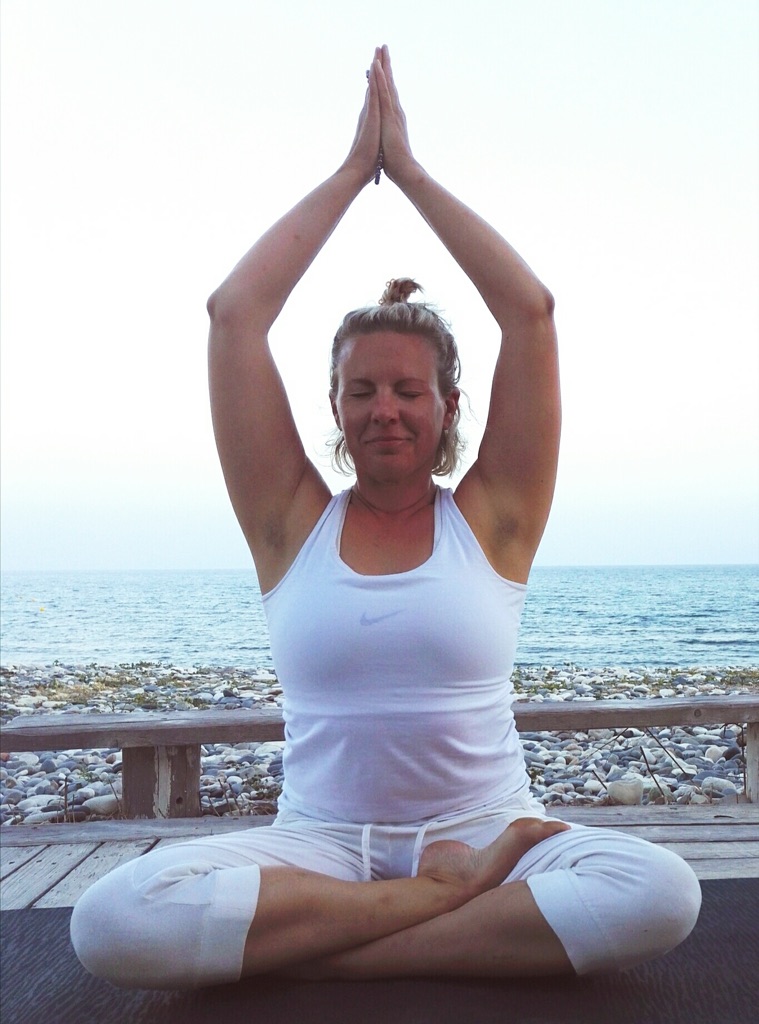
    Those of you who have been to my classes over the past few weeks might remember the Om So Hum – Mantra from the beginning and end of the classes. With some of you I talked briefly about the message of this mantra but I wanted to share it more widely here in the blog too.

    First things first though, what is a “mantra”?

    The literal Sanskrit meaning of the word can be roughly translated as “tool of the mind”, as the root “man-“ means “mind” and the suffix “-tra” refers to “tools or instruments.” Very bluntly put (and bearing in mind that there is no single definition for mantra agreed by all), mantras are thoughts, prayers, sounds or words/phrases, believed to have spiritual or psychological powers. Mantras are repeated silently in the mind or aloud (for instance by singing) and often have the aim of helping the mind to silence and focus in meditation.

    The literal Sanskrit meaning of the word Mantra can be roughly translated as “tool of the mind”, as the root “man-“ means “mind” and the suffix “-tra” refers to “tools or instruments.”

    I am going to leave that definition hang in there for now although obviously there is A LOT more to history, definitions and meanings of mantras.

    There are countless of mantras in the world but what does “Om So Hum” mean specifically?

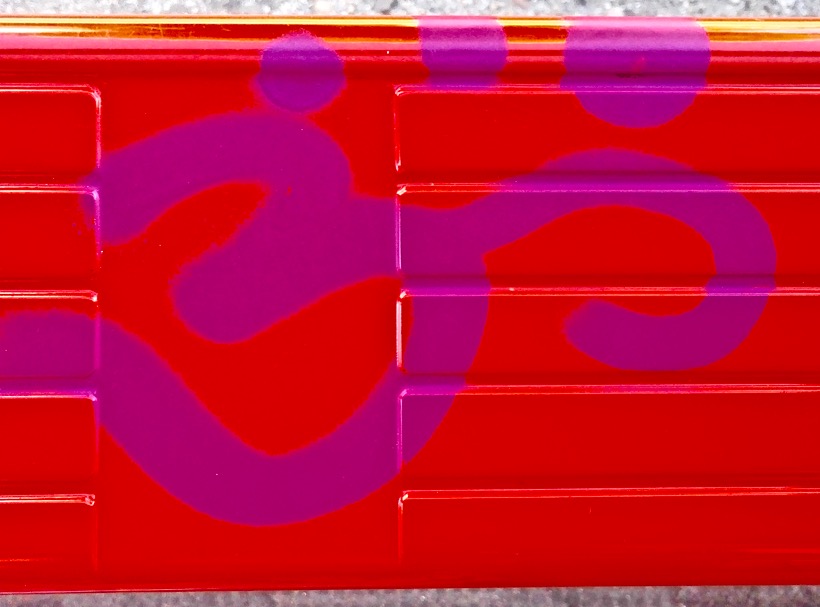
    OM (Actually it is Aum but we’ll leave it for now) = Familiar to many from a yoga class, OM is an ancient Sanskrit letter and a sacred syllable. It is often described as the Sound of the Universe, the most elemental of vibration, a sound that attunes to the our true nature. It can be used as a mantra on its own.

    So Hum = Reflecting the sound of the breath, so hum translates as “I am that” or “I am this.”

    Put together, “OM So Hum” therefore translates roughly as “I am the Sound of the Universe”. It can be interpreted as a mantra connecting us with the Universe and everything that is.

    Enjoy the mantra!

  • About Yoga, Spirituality …and Discussion Forums.

    About Yoga, Spirituality …and Discussion Forums.

    Recently I have been reading several articles and studies on the growth of fitness and wellness boom during this decade which, as most of you I am sure would agree, does not show any signs of slowing down.

    Yoga is of course an integral part of this growth and according to one study I came cross, “yoga” was among the 15 most Googled words in 2017 in the UK ! Furthermore, in 2016 Yoga Alliance and Yoga Journal found out in their study entitled “Yoga in America” that whilst 28% of the American yoga practitioners are male and 72% are female, there had been a 250% increase in the male yogis between 2012 and 2016! My purely empirical observations across yoga studios in various European countries helps me to have confidence in that in the Old Continent the tendency is the same – and this is wonderful news obviously!

    Whilst 28% of the American yoga practitioners are male and 72% are female, there was a 250% increase in the male yogis between 2012 and 2016.

    “Yoga in America” Study of 2016.

    People come to yoga for different reasons: to alleviate back pain or other type of  physical discomfort, as a means to deal with stress, anxiety and insomnia, as an alternative form of physical exercise… with so many styles and yoga teachers out there these days there is a yoga class to suit everybody. However, there are as many yoga stereotypes out there are as there are styles of yoga. And as with all the stereotypes, they do not come completely from nowhere, just as much as they do not represent the whole truth either. Yet, they can still form a barrier of entry for those who are curious but sceptical about yoga.

    One of the more common remarks I hear from people who express interest in yoga is the concern about the level of spirituality that they might come across in a yoga class. About a year ago I wrote about this topic after I had stumbled upon an interesting conversation thread touching upon this subject on Reddit which I am re-posting here for the benefit for those of you who did not see it the first time around (Hello You! Thank you for reading my blog!)

    So, this Reddit conversation started by this brilliant comment:

    ”I started yoga about two months ago and I am really enjoying it. I’m a 30 yo male. My back feels great despite my 40+ mile running weeks and I am already a lot more flexible.

    But I’m somewhat turned off by the spiritual and meditative aspects of it. I don’t care about dedicating my practice to something, sealing my intention, being one with the ground, or anything like that. I just want to work on strength, stretching, and flexibility. I have only tried two studios so far and they are both pretty heavy into the spiritual/ meditation part of it, and the websites for all the others around me give the same impression.

    Is this something I just have to get used to?” […]

    My first reaction was laughter because this so hit the nail in the head. Just last night when teaching a class I encouraged people to “set an intention” at the start, and during savasana I said something along the lines of “feel supported by the ground.” Touché!

    The second reaction I had was to get a little defensive. ”Well, technically we ARE supported by the ground when lying down, nothing spiritual there.” However, we all get the gist of the comment and many of us either recognise ourselves in it or know somebody who shares the feeling.

    There were many great comments in the threat as a response to the above. Many expressed having similar feelings. Some suggested taking up pilates or other type of a stretching/conditioning class rather than yoga, no spirituality there. Some expressed their disapproval of what they saw as not understanding or trying to embrace the whole concept of yoga and everything it entails. Several people identified themselves as “atheist engineers”, leaving me wondering if this is seen as the highest form (or just stereotypical?) of a scientific and pragmatic individual, immune to any type of “spiritual bullshit about chakras and stuff.”

    The comment that was voted the best started with “Dedicate your practice to fitness. Seal your intention to workout like a m*********r.” The runner up commentator chipped in with, ”most of what sounds like spiritual hippie nonsense is actually creative language/metaphor leading you to a concrete action: focus. You can tune out and just do the moves, but without breath and focus, you are headed for injury.”

    I liked these comments a lot and I find them genuinely helpful. Of course as a yoga teacher I do believe in what I say in my own class but I also get that some of the stuff might sound a bit out there for some. Like with everything, not every yoga class, teacher or style resonates with me either. But it is always my choice how I choose to go about things and how to own up to my choices in a given situation. I trust the teachers whose classes I take to be professionals and having something to offer and therefore deserving my attention: this is also about safety. I can then choose to go to a different class next time – there are plenty of yoga classes with very minimal spirituality (or offering a different way to go about it) in them on offer.

    I guess the point I am trying to make is that it is ok to have questions and even doubts but do not stop them having a go at yoga if you are interested. In a good class nobody is (or at least should not) force anything spiritual or esoteric down your throat. Be open-minded, remember that there is more and more hardcore scientific evidence about the benefits of yoga and meditation (watch the video I posted earlier on this topic here) and see for yourself.

    What amount of spirituality in a yoga class feels right to you?

    Namaste

  • 5 X Daily Routine To Stay Grounded and Keep Going

    5 X Daily Routine To Stay Grounded and Keep Going

    Whether you find it boring or not, there are a lot of good things to be said about daily routine: Several studies have proved that having a routine can, for example, reduce stress, improve sleep and consequently lead to improved health. Other benefits of routine include the possibility of eliminating certain time consuming tasks from your days completely so you can focus on the essentials: Hence the distinctly always-the-same sartorial choices of Mark Zuckenberg, Barak Obama and the late Steve Jobs.

    However, even with a very regular schedule it can sometimes be very easy to start feeling overwhelmed, demonstrating as anxiousness, stress, and lack of energy and/or motivation. Then there are the days when even the best laid plans and intentions seem to fly out of the window and life feels like one big game of never ending catch up.

    Whilst there are no miracle recipes to stay cool and collected in every situation, here are my top five daily routines to help me to stay (or return to feeling) rooted and calm(-ish.)

    Coffee with a view

    1. Morning Stretch and Mood Setting – In Quiet

    Having a stress free start to the day is an absolute must for me. I rather wake up an hour early to have a relaxed morning than experience a mad rush first thing when opening my eyes.

    The old saying “start as you mean to go along” is something I try to apply to every day.

    Whilst I am just as likely to hit to snooze as any other person, I take the time in between to have a slow, gentle stretch with my eyes still closed, waking up my facial muscles, wrists, ankles one by one, followed by a spinal twist to both sides. I also stay away from electronics, radio or any other source of noise for at least 15 minutes after getting up. Instead I might do a small meditation, have a look at my paper calendar or have a chat with my housemates whilst making about the coffee, checking in how we slept and how do we plan to tackle the day ahead.

    Some days it is of course harder to get out of bed but as they say, sticking to a plan can become a habit in less than a month so if your mornings always seem manic, maybe this is something to try?

    Viparita Karani

    1. Glass of water and Breath of Fresh Air

    Nothing new with this one but routines are not about what you know, they are about what you do. There is no need to stress about the lack of fresh lemon to squeeze in your water – this is Instagram free time anyway so have that glass of water next to your bed if that is the best way for you to remember to down it.

    As for fresh air, opening the window and taking in few deep inhales and exhales counts too. 30 seconds is all your need. If I can make it for a brisk walk even better, although I always aim this not to be a mad rush for the bus.

    1. The mid-day/afternoon 5-10 minutes time off – Again, In Quiet

    Especially in bigger cities there is noise absolutely everywhere! If you do not have the opportunity to escape to the forests/beach on a regular basis (I am thinking of you lucky Cypriots and Nordic people!) you might have to get very strict about this but trust me, it is so worth it. Put it in your calendar and lock yourself to the nearest toilet cubicle, or use headphones to block the outside noise as much as possible.

    There was a time when the saying “if you do not have 10 minutes to meditate, take an hour” used to drive me insane, even if I deep down realised how much truth there is in it. It does not even have to be 10 minutes, and it does not need to be a meditation. Just sitting in stillness and letting the breath work its magic usually does the trick.

    If you are sceptical, try this just once: Find as quiet place as possible and close your eyes. Sit on a chair or whatever is comfortable and have your hands on your knees, palms facing upwards. Relax your facial muscles and jaw and take ten deep inhales and exhales, trying to keep them as even length as possible.

    How did it go?

    1. Feel the bodyweight to root and rebound

    With increasingly sedentary lifestyles it is no surprise many of us feel disconnected from our bodies. We might experience aches and pains but are not able to locate or describe them in a clear manner, and “body coordination” can make sense as a term but not as something we would say we are good at.

    Just as having a quiet moment or two every day can help with increasing our mind-body-soul awareness, I also find using my body weight to actually feel the physical edges and capacity (or non-capacity at certain moments) something I need to do every day. The beauty of this is that it does not mean a daily trip to the gym or yoga studio, this is something that can be done in five minutes and in pretty much any type clothing.

    Some of my favourites “just checking in” body weight exercises are:

    • Planking (knees up or knees down)
    • Side planking
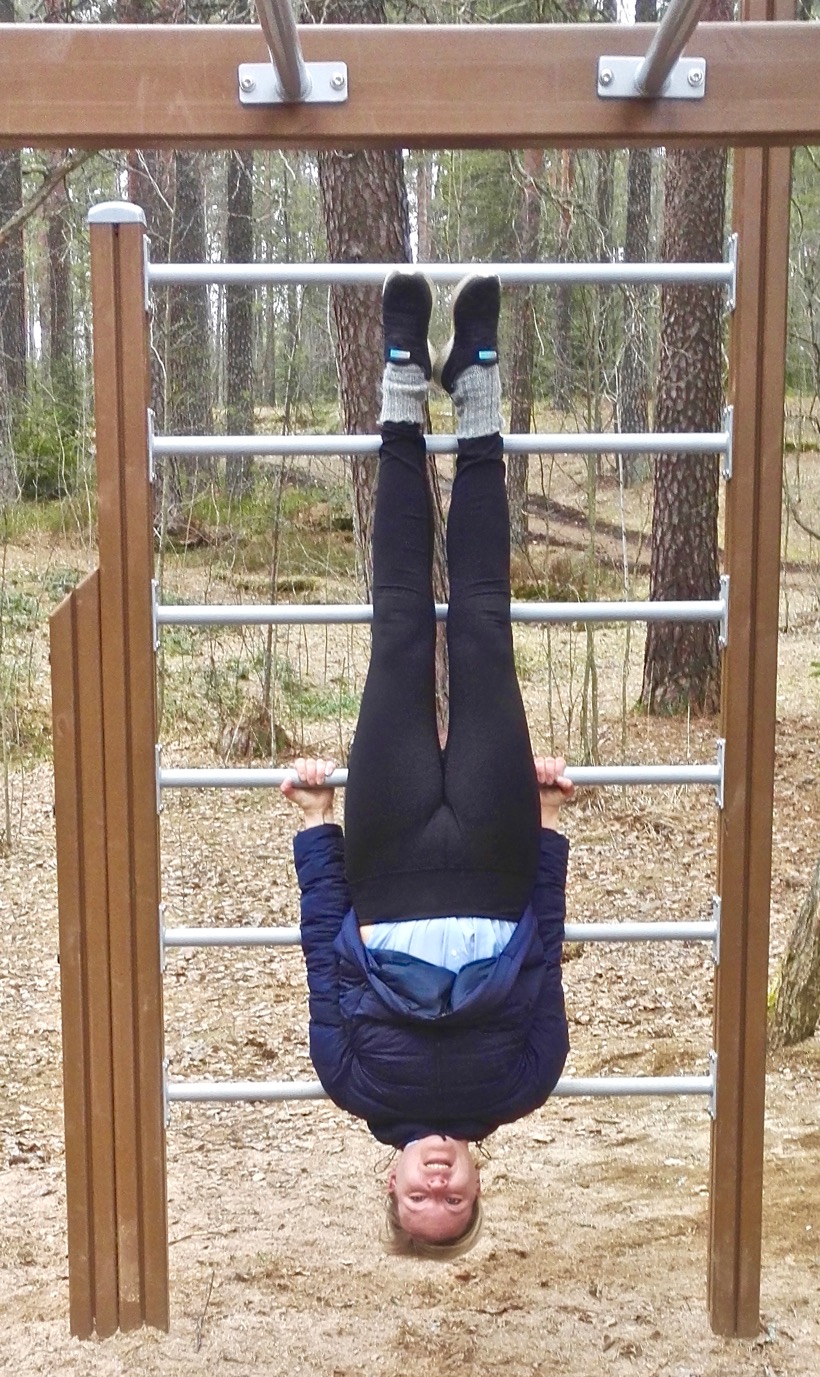
    • Hanging off a wall bar or a sealing bar (the metal bar connecting toilet cubicles is perfect: this used to be my go-to office pick me up, perfectly do-able in a suit and heels. Unfortunately I do not have any pictures.)
    • Reverse table top (also known as crab pose)
    • On a chair pressing down with your arms and lifting your bum and legs up (L-sit variation)
    • Handstand/cartwheel/any inversion

    The above might sound a bit crazy but hey, you can go to the gym and do dead lifts, or you can just practise lifting yourself. For the latter, do you really have any excuse?

    1. Approach your bedtime with the respect it deserves

    The other bookend of the day, bedtime, is just as important as the way you wake up. It really is worth the effort to put the phone away even 30 minutes before bedtime. An analogue alarm clock costs about 5 quid/euros (I just got a new one for myself) so you can even leave the phone to a different room all together. If feeling too fidgety for a silence straight away, try to old school before sleep activity of reading a book, a comic or a feature story in that free magazine you picked up three days ago.

    I find it easiest to ban all electronics from my bedroom at all times. That way I do not even have the opportunity to quickly check my phone the first thing in the morning or last thing in the evening. As I have to be physically up to get to it, having a good stretch or a cup of tea/coffee becomes just as feasible – and often preferred – action to take and in no time, a habit.

    What is your main daily routine that help you stay grounded and going every day?


  • About New Year’s Resolutions and How to Stick With Them

    About New Year’s Resolutions and How to Stick With Them

    Whilst we are free to make small and big resolutions any time of the year – or day, for that matter – The New Year is very much seen as THE time to make a change or few in one’s life. Just look at the amount of people you see at the gym during the first two weeks of January or alternatively, how pubs and bars seem emptier, especially mid week.

    The issue with resolutions is not the resolutions themselves – that is often the easy part. The real difficulty is how to stick with them after the initial days or weeks when the first enthusiasm and heightened sense of self-discipline have started to wane. Here are few ideas on how to get through the difficult patches when all you want to do is not to stick with your ideas.

    First one is the favourite of every life- and career coach (and a true fact too): If you have a big goal to attain, break it into several smaller ones. Of course you do not want to lose the sight of the end goal but rather than start feeling overwhelmed by it, approach it in smaller chunks. Just keep thinking how many rivers make an ocean and trust that with several small goals the big one will come, in due time. And if at some point you veer off the course, remember it is just temporary: One lost battle does not mean you are losing the war either so get back on track as soon as you can and carry on.

    Trigg Planner

    Use old school squared paper and pen!

    A start up magazine I bought for my latest flight had a tip that apparently originates from the comic Jerry Seinfield: using a piece of squared paper (placed somewhere where you can see it easily and every day) and a pen to track your daily progress in regards to whatever it is you want to achieve. Be it about meditating every day or not drinking for a month, the daily cross on the paper releases the dopamin in the brain as you gain a sense of satisfaction from tracking your progress in a visual way. This can also help you to get through those moments of “I will skip it just today…” as you do not want to interrupt the flow of the Xs on your square paper. A gap in a row might be just the thing to boost your willpower – and help you to get one step closer to your goal.

     Use a planner, as fancy as you want!

     I am one of those people who loves lists, mind maps, journals and coloured pens. Which is all fine and well but to truly make progress you need some kind of a plan and a follow up system too. Otherwise it is very easy to get side-tracked by the daily grind whilst certain items on your to-do list keep on being pushed to a “better time” and goals made become more and more elusive.

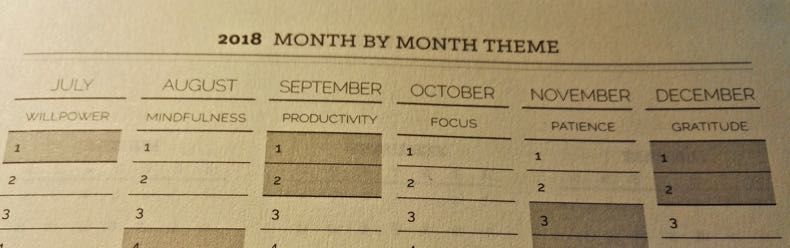
    Last year I used a bullet journal that worked pretty good – but not good enough for me not wanting to try something else for 2018. There are several ready-made planners out there and I settled to a UK designed one that lays out a theme for every month, helps you to classify stuff you want to do from urgent and essential to nice-to ones, and offers space for reflection before and after each month, with already laid out questions! A perfect solution for those inevitable moments when motivation is low and the last thing you feel like doing is to think at all. I got the same planner for my flatmate, in the name of peer support and well, keeping each other going.

    EDIT. I have gotten a lot of questions about what this planner is. It is called Trigg Life Mapper. This is not a commercial collaboration, after few days of researching I settled to ordering this one and so far I like the look of it. The pictures of this post are from Trigg Life Mapper.

    Working methods quote

     It is of however important to remember that life should not be only about performance and accomplishments. Plenty of scientific studies have proven that for the wellbeing of the brain and body alike it is important we spend time each day to rest and be still, without any pressure to achieve anything. It is good from time to time to also allow ourselves to get bored as boredom has been proven to feed creativity in adults and children alike.

     Our New Year resolutions should not however become an obsession that dictates everything we do during the day. Not everything can be controlled and a gap in the row of Xs on a square paper is not the end of the world. The real strength, one that we all do have in ourselves, is to face difficult moments as they are. It is ok to get annoyed and sad but equally important take on board any lessons to be learned and to move one. There are usually many ways to reach our goals and adjusting the plan on the way is entirely possible.

    What type of methods do use when planning your goals and how to achieve them? Leave a comment below!

  • The Difficulty of Being Honest with Yourself

    The Difficulty of Being Honest with Yourself

    One of the hardest things in this life is to be honest with yourself.

    The first reaction when I hear this phrase is to be in a state of complete denial. “I am realistic,” I’ll say to myself.

    “I know what I weigh, I am happy to list my development points if asked in a job interview and my insurance company knows I am a social smoker.“ And I suppose these statements are all true and admirable. No problems there.

    But I am talking about the deep shit, the stuff that is so deep under the surface, sometimes confusing, that we don’t even want to talk about it. Or in some cases, we talk about it all the time, overanalyse every detail over and and over again, convincing ourselves that we are ok with how things are.

    Yet, if we were to take a moment to be silent, uncomfortable feelings may surface. Feelings that are hard to grasp because they have been buried through days and months of a life bombarded by noise and constant action.

    These are the feelings that tell us the truth -the real truth- as to what is really going on deep down inside. Some call it intuition, some call it a gut feeling or inkling. I’m sure you know what I am talking about, because we all had moments when that feeling came so strong we could not ignore it. And whether you listened to that gut instinct or not, you knew deep down what the right thing in that situation would have been.

    But why is it that we often find it so hard to acknowledge what our mind and body knows all along?

    I am convinced that in most cases it is because of fear.

    Fear of having to walk away from situations and people we have become attached to, even though they are less than ideal.

    Fear of what other people might think if we go with our gut feeling.

    Fear because we cannot rationalise our intuition and it can often go against what would make sense rationally.

    Fear of the unknown and the anxiety of making the wrong move, regardless of what everything in our gut tells us otherwise.

    Fear for making a truly honest assessment of where are at.

    So how do we know it is time to take a moment and have a long, hard, good look inside? How do we recognise that something inside of us is trying to send us a message?

    It often starts with that quiet inner voice that something is off. It can be very hard to pinpoint what that “something” is, especially if everything seems to be just fine on the surface. Odd feelings can come and go, but if these feelings keep coming back – it is worth to take a pause and check in.

    The truth is not out there. It is inside. It is a long and difficult road to understand ourselves, but remember that the truth is alive and living in us. When we slowly begin to understand and connect to our inner truth, it can take some time to get comfortable with the feelings and emotions that comes with it. But there is no reason to fear this. The key is to take all the time that is needed. Days, weeks, months, sometimes years. It might feel overwhelming (again) but celebrate this journey and continue on making time for these moments to yourself on a regular basis, to check in and evaluate.

    Journal, reflect, whatever is needed. Dig deep for the honest connection with yourself.

    And remember- your truth is yours, and yours only.

    The first version of this text is published on Happy Girl Yoga.


  • The Open Yoga Day Cyprus 2017

    The Open Yoga Day Cyprus 2017

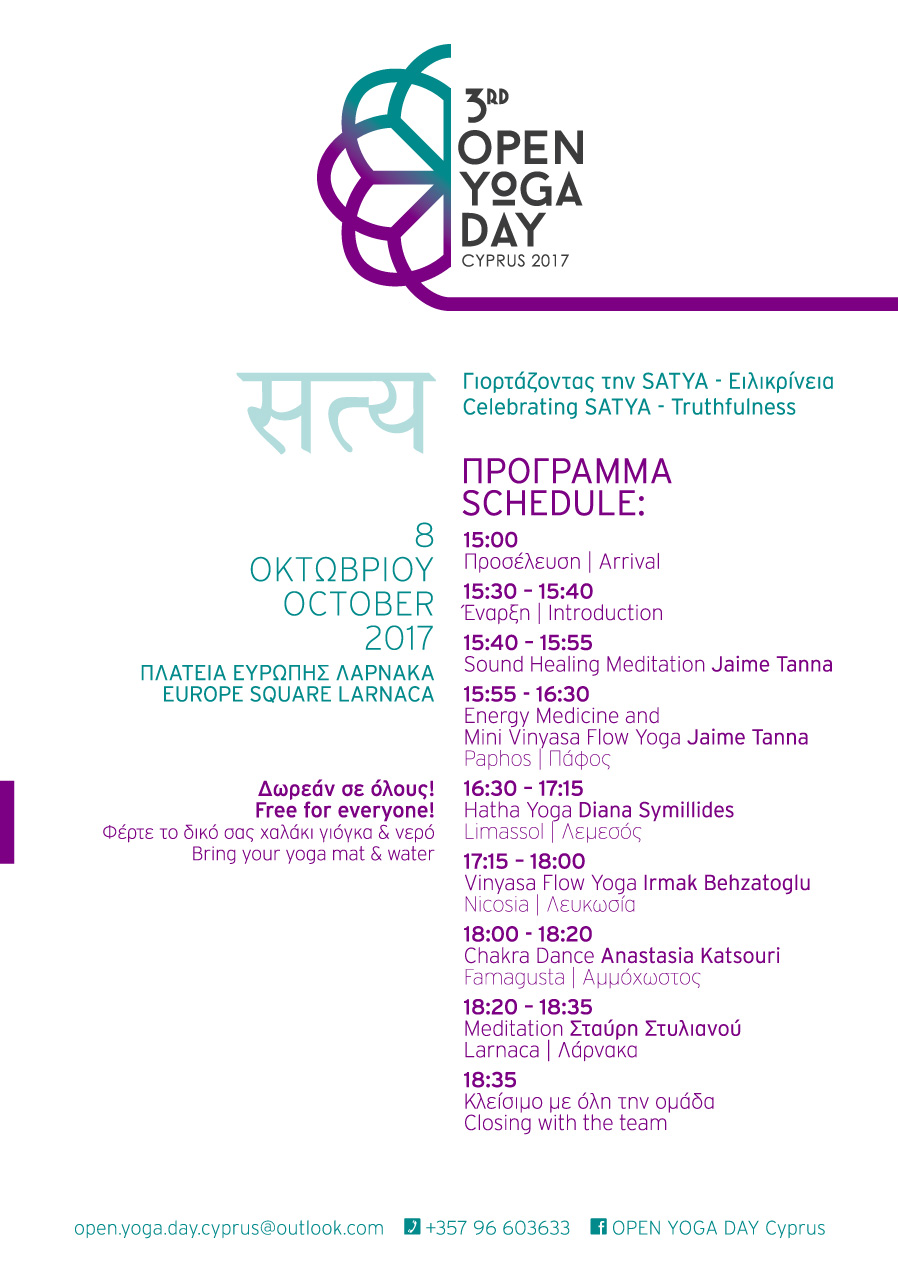
    The Third Open Yoga Day Cyprus is coming up on the 8th October, hosted this time in Larnaca, under the theme of Satya, truthfulness. To learn more about this free & open for all event I sat down with two of the organisers, Mayka Sabova and Marilena Shyama Shakti, for a chat.

    This is the third year this event is being held in Cyprus. Where did the initial idea for the Open Yoga Day Cyprus come from and who are the people behind it?

    Inspired by similar events around the world, the Open Yoga Day Cyprus was founded by Marilena in 2015. There are many community events in other countries that offer various kinds of free services to citizens. The main principle of these types of events is to find enthusiastic and like-minded people who are willing to offer selflessly to others, without expecting a tangible reward in exchange.

    These days it can be rare to find people who have the ability to offer selflessly, people who are committed, loyal and driven to dedicate their free time and energy for creating something for others. Yet these are the qualities of the people behind the OYDC. We share passion for yoga and we aim at bringing it to as many people as possible. Alongside our founder, we are a small group of volunteers (mostly yoga teachers and practitioners), who share the common vision and are willing to walk an extra mile for the benefits of others. We operate with the support of local municipalities and every year we have few private sponsors and supporters who offer financial or other assistance.

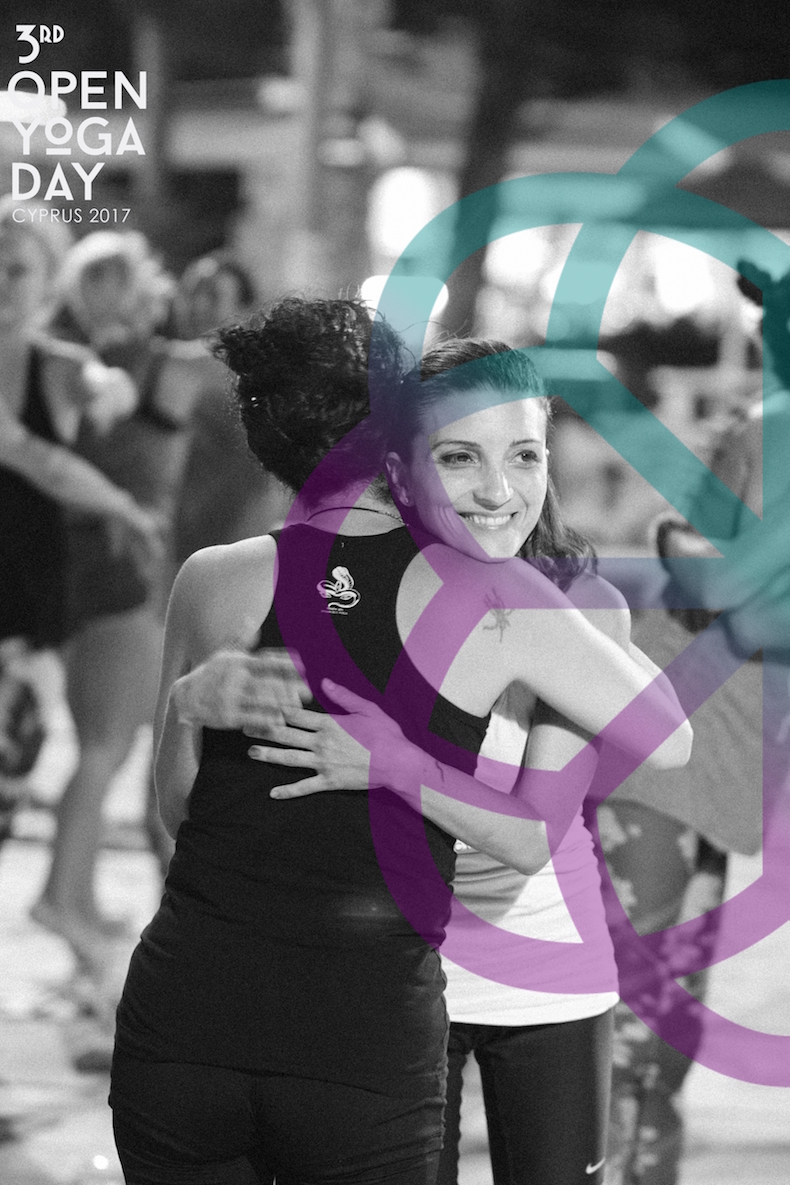
    Yoga Hug

    In addition to fostering a community spirit and sharing the passion for yoga, what is the main message you wish to promote with the Open Yoga Day Cyprus?

    Our vision is to promote wellbeing through yoga, while contributing in building healthy communities. The more people practice yoga, the better our society can become. We want to offer an opportunity to everyone, regardless their level of physical fitness, age or familiarity with the practice, to try yoga, enjoy the outdoor group practice and cultivate the sense of belonging and unity. The world has become more and more selfish with people focused strictly on their own lives without considering the others. With this even we want to encourage people to interact. In this sense, we use yoga as a tool for social interaction, while spreading the message of selfless giving, togetherness, sharing, love and unity.

    These are also the reasons why the event is organized every year in a different location across the island. This way, the people already familiar with the event mix with newcomers and the message can reach more people.

    This is the third time the Open Yoga Day Cyprus is taking place. Have you noticed any changes in the yoga community in Cyprus during this time, and has that influenced how you are setting up the event this year? 

    We noticed that more and more people have started practicing yoga over the recent years, and more and more of them have become yoga instructors too. This has not influenced the way we planned our 3rd edition, but it will influence the future events to come. For instance, we would like to bring new instructors closer to the more experienced ones, as well as the new approaches of teaching yoga with traditional ones. In yoga we learn to go with the flow so we try to go with the flow of changes, the evolution of the yogi community and most importantly, with the flow of people so we can all open up, learn, feel and grow further.

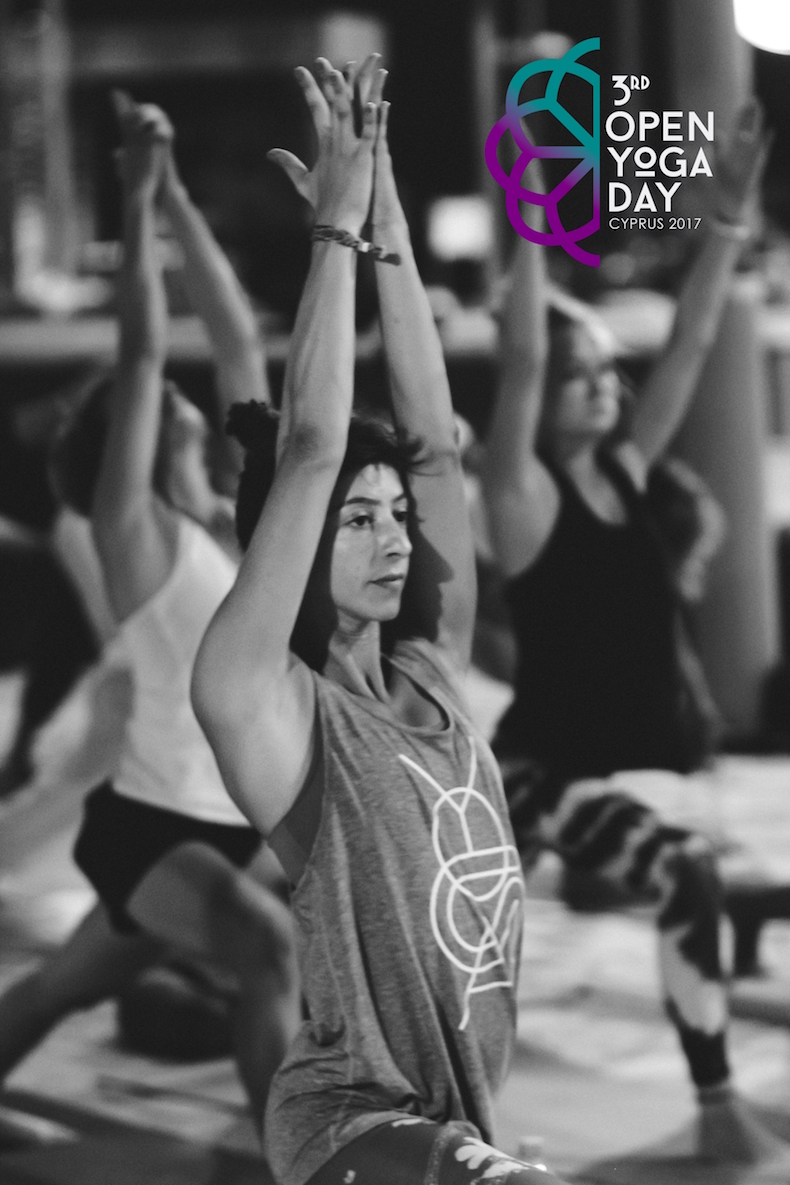
    Black and white sun salutation

    How did you choose Satya, truthfulness, as the theme for this year?

    Every edition of the event has a set intention. The power of collective intention is immense and when we do things, whatever they are, with an intention, we deepen the purpose of any activity. This year our intention is Satya, truthfulness. Satya was chosen by the founder of OYDC, Marilena Shyama Shakti, as the theme of this year’s event after she went through the gift of being pregnant and giving birth. For her, the experience of giving birth to a new life was so true and real and, of course, deeply personal, with truthfulness present in every moment. Whether it was the eye contact, reactions or the sounds of the baby, all of these profoundly impressed Marilena, as it made her realize that human beings are born so pure and it is our duty to preserve the ability to stay innocent and true to ourselves.

    I don’t want to get ahead of things as this years’ event is still ahead of us, taking place on the 8th October, but can you already talk a little bit about your future plans?

    We wish to bring yoga community in Cyprus closer together by encouraging those who share our values to offer their services and contribute in any way they can. For this purpose we would like to boost our reputation as a non-profit initiative through the annual event, and perhaps with even more events in the near future. We promote yoga, which indirectly benefits all yoga teachers across the island as we create potential audience for them. Therefore, we would like yoga teachers and instructors to bond and cooperate through our events in order to create an effective and efficient yoga hub.

    We are also collecting data about yoga instructors and centres across the island, with a vision to create a central online yoga platform with directories and many other features. Everyone who wishes to give something back to the community and is ready to offer selflessly can reach out to us and contribute with their talent, skill or service.

    Thank you very much for your time Marilena and Mayka – I am sure this years event in Larnaca will be even bigger than the events of the past two years. I’ll see you in Larnaca on the 8th October!

    Click here for the Open Yoga Day Cyprus’s Facebook page and check out the programme of the below. The event is open and free for everybody but you are requested to bring your own mat and something to drink.

    Cyprus Yoga Day Programme

    Tallenna

    Tallenna

  • International Yoga Day in Platres

    International Yoga Day in Platres

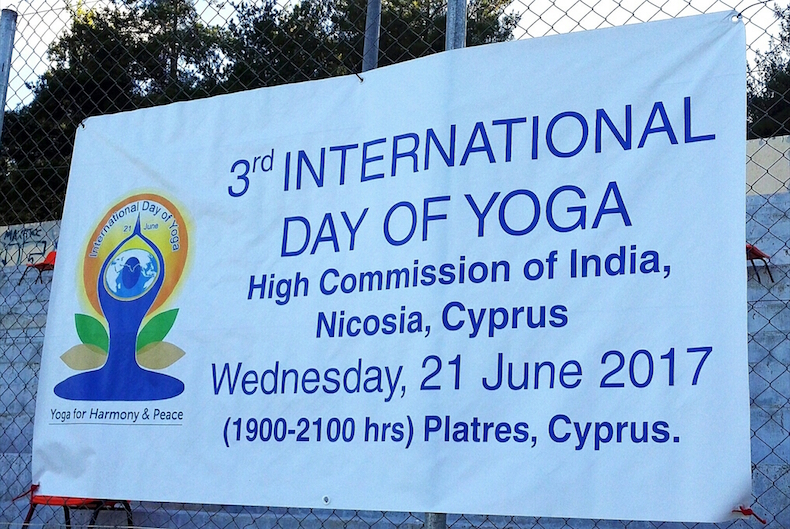
    Since 2015 the 21st June has not only marked Summer Solistice but also the International Day of Yoga, as agreed (by an unprecedented consensus) by the United Nation’s General Assembly in December 2014. The idea to observe Yoga Day came from India’s Prime Minister Narenda Modi who at the time stated:

    “For us in India, respect for nature is an integral part of spiritualism. We treat nature’s bounties as sacred. Yoga is an invaluable gift of India’s ancient tradition. Yoga embodies unity of mind and body; thought and action; restraint and fulfilment; harmony between man and nature; a holistic approach to health and well being. It is not about exercise but to discover the sense of oneness with yourself, the world and the nature. By changing our lifestyle and creating consciousness, it can help us deal with climate change and in bettering our well being. Let us work towards adopting an International Yoga Day.”

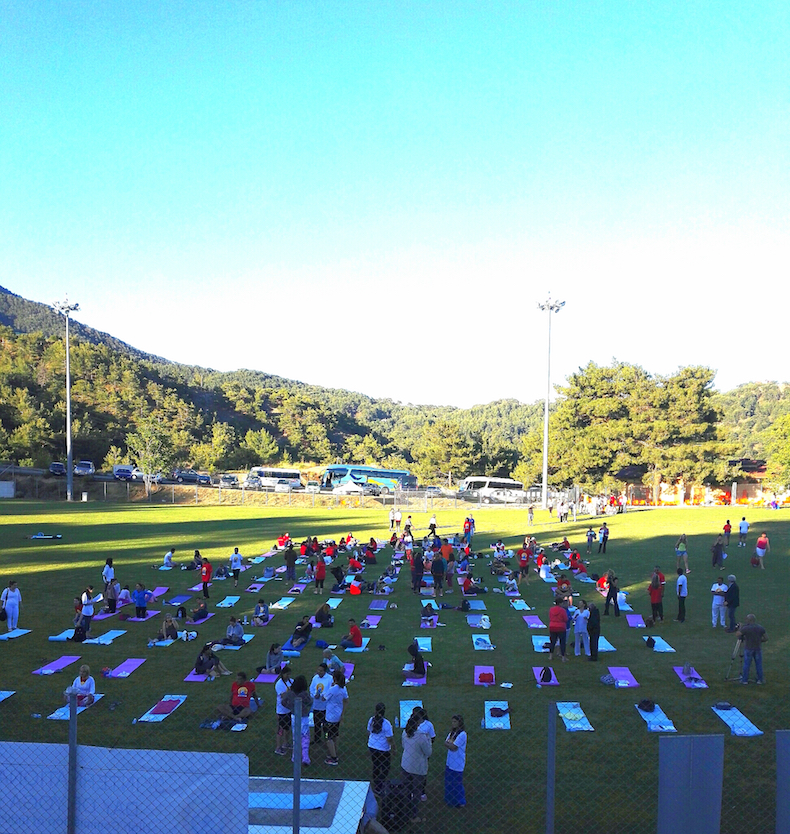
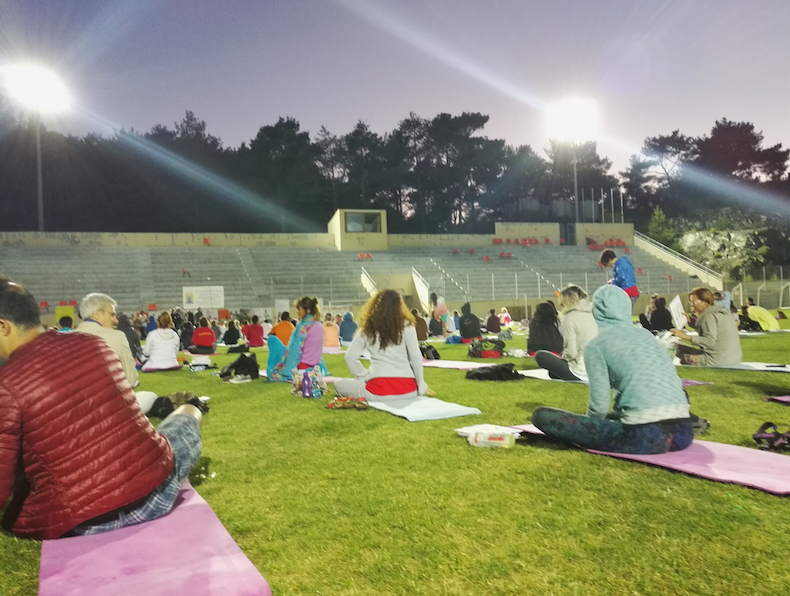
    Ever since its conception Yoga Day has been embraced internationally with mass yoga sessions across the world, from Times Square in New York to events hosted in rural villages. The latter is exactly what took place in Cyprus this year. For the 3rd International Yoga Day the High Commission of India to Cyprus organised a sunset mass yoga practise in collaboration with the Community of Platres, a village situated some 1000 metres above the sea level in the Troodos Mountains. It was a beautiful event with great level of participation, definitely worth the drive up the mountains.

    Here are some pictures from the event.

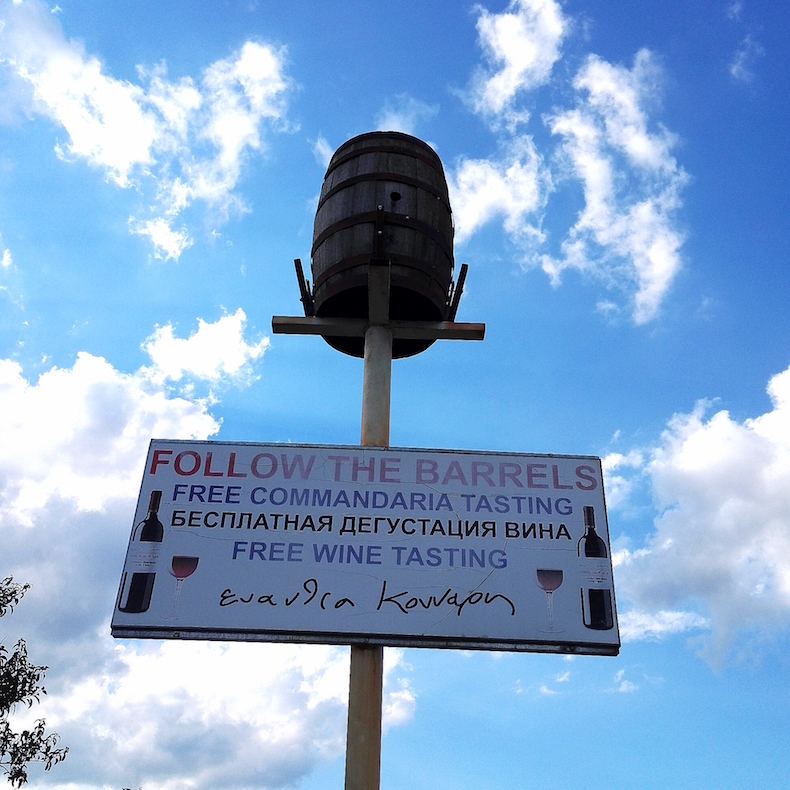
    CommandariaSign
    No Commandaria for me!
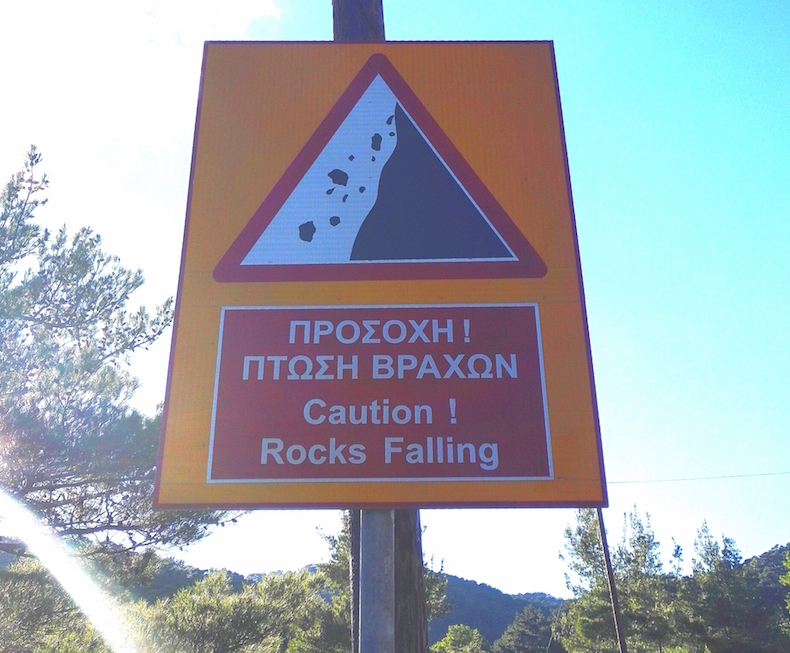
    CautionRoadSign
    Not even falling rocks could have stopped me!

    Crossroads

    Platres Athletic Centre

    MassYoga

    Yoga Event

    How was your International Yoga Day?

    Tallenna

  • 7 Yoga-inspired Tips for Anxiety and Stress

    7 Yoga-inspired Tips for Anxiety and Stress

    This past week has been the Mental Health Awareness Week. However, mental health is obviously not an issue just for one week a year, just like a good mental health is more than just absence of a mental health problem.

    Stress and anxiety for instance are issues that touch all of us at least some point in our lives: school or university exams, professional demands and relationship challenges are unavoidable but luckily there are way s to ease their toll on us. It widely recognised through clinical studies that yoga can be an effective way to help us during tough times. Here’s how.

    1. The power of breath – pranayama – brings calm and relieves anxiety. There are various breathing exercises available and you can find few of them here. If you prefer keeping things simple, just focusing on lengthening inhales and exhales, whilst breathing through the nose, is a very effective way to bring stillness to the mind. You can try counting during inhales and exhales to help to keep the rhythm even, with the added bonus that when you count quietly in your mind, it is pretty hard to have other thoughts disturbing you.

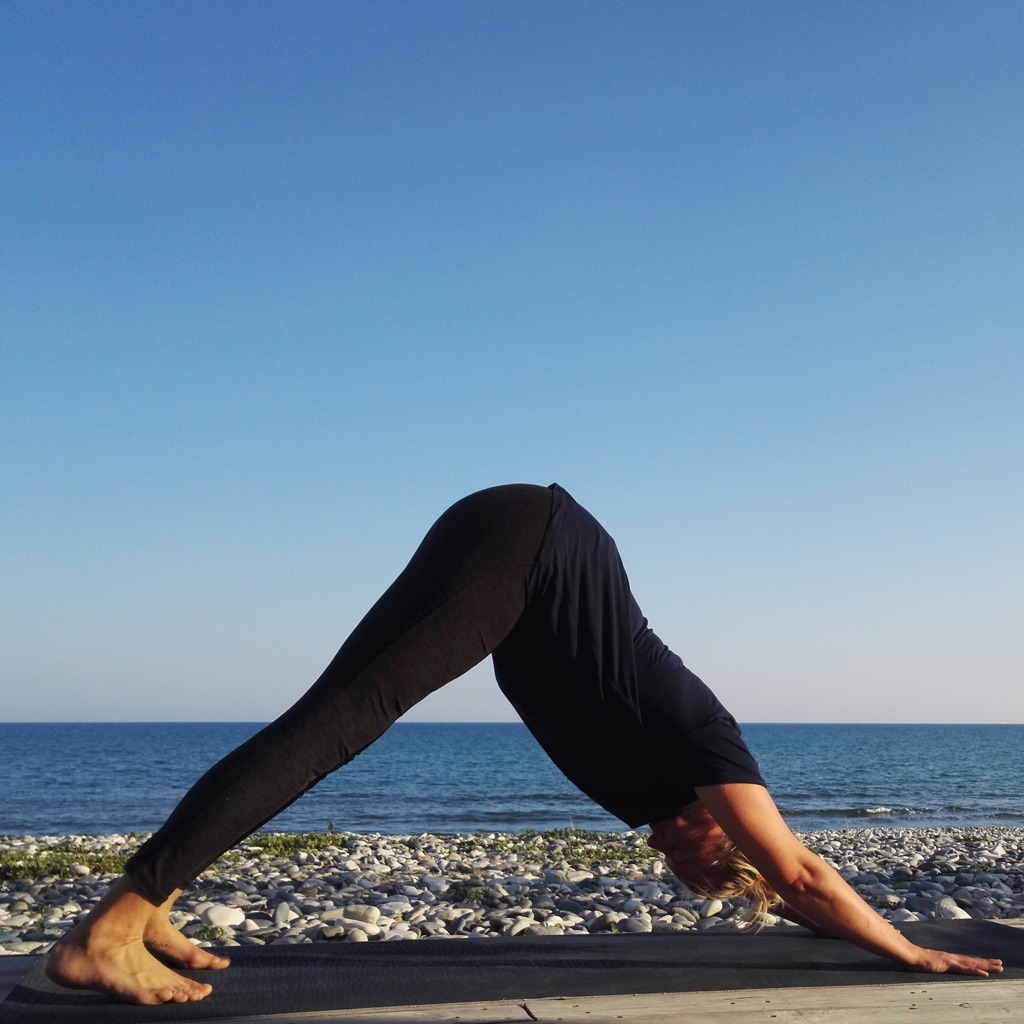
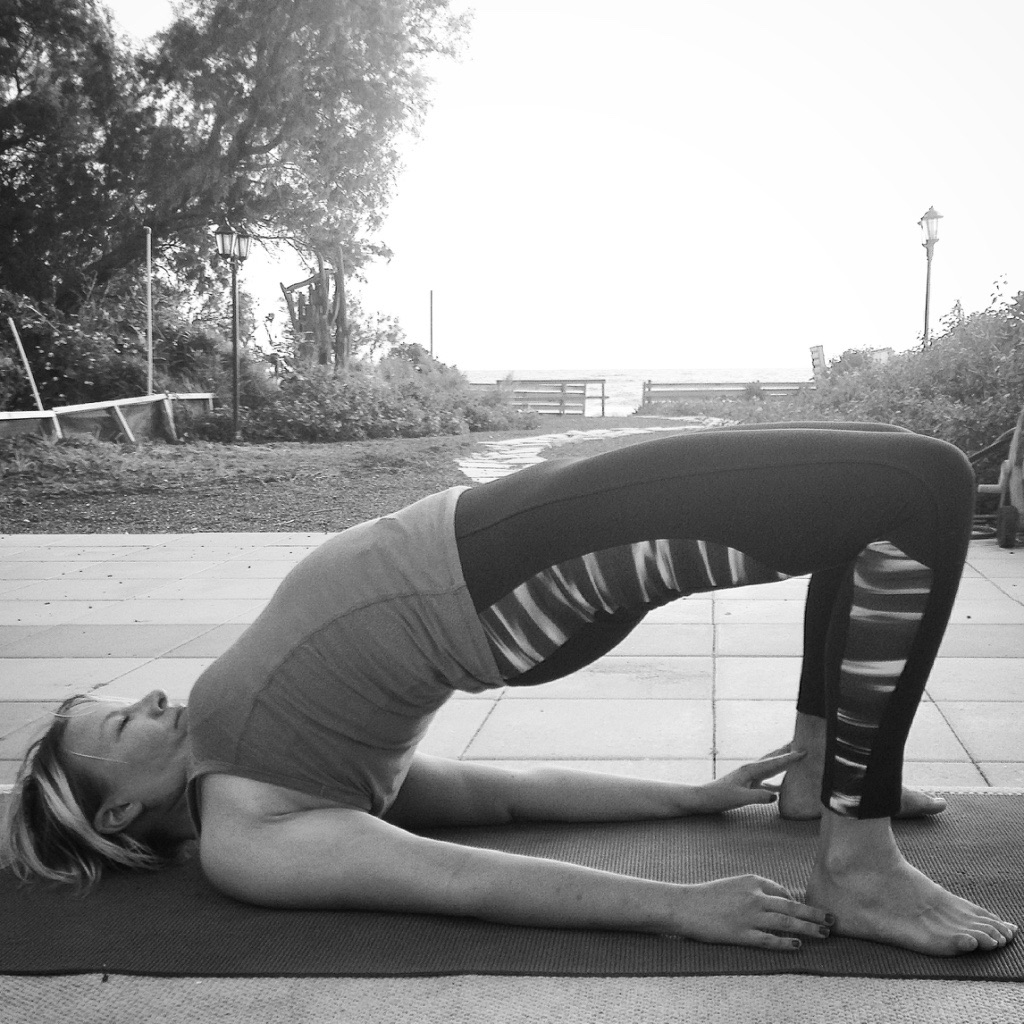
    2. Yoga postures – the asanas – relief physical tension and can help the mind to refocus. Some of the asanas that are especially recommended for relieving anxiety are hastapadasana (standing forward fold), adho mukha svanasana (downward facing dog), setubandasana (bridge pose) and of course, savasana (corpse pose.) Even a ten minute practise a day, done regularly, can have a huge positive impact.

    3. It is said that well planned is half done and preparation is the key. If you are reading this the night before a deadline you might find this annoying but take the lesson and next time plan ahead. Carving out the time to preparing in advance and making a plan will help manage both the situation at hand and our reactions, even if things end up not going to that plan (and do they ever?) If we are disciplined with our yoga practise, we can be disciplined with other aspects in our lives.

    4. Find an affirmation that works for you to start the day. For instance, making a conscious decision every day to act with best of our abilities means we are less likely to have regrets and more peace of mind.

    5. One of the reoccurring themes in yoga is that everything – absolutely everything – is temporary. Things will pass. It might not always feel like and it can be annoying to be reminded of this when the feeling is everything but. But things will pass.

    DeepYogaBreaths

    6. Meditation, with help of an app or without, does not need to take more than few moments. It is always helpful to check in with ourselves to inquire how we are REALLY feeling and why, even more so if we have a chance to remove ourselves temporarily from a taxing situation. Noticing what triggers our worries and concerns might take some time initially but will pay itself generously back once we learn to take preventative actions.

    7. Feeling like going all the way with a lifestyle change? Always best to introduce changes slowly in order to make them stick but if you are ready to go for it, check out my post about yamas and niyamas for some inspiration.

    To the beach

    Tallenna

    Tallenna

    Tallenna

    Tallenna

  • 7 x Joogan inspiroimaa vinkkia stressin hallintaan

    7 x Joogan inspiroimaa vinkkia stressin hallintaan

    Mennyt viikko oli henkisen hyvinvoinnin teemaviikko (ainakin joissain maissa) mutta aihe on ajankohtainen vuoden jokaisena päivänä. Hengen ja mielen hyvinvointi kun on paljon muutakin kuin mielenterveysongelmien välttäminen. Koulu ja opiskelu, työelämän vaatimukset ja ihmissuhteet aiheuttavat useimmille meistä stressiä ja ahdistusta jossain vaiheessa elämään. Vaikka näitä tilanteita on hankala välttää kokonaan, voi joogasta löytyä iso apu elämän vaikeiden vaiheiden helpottamiseksi. Alla muutamia keinoja miten.

    1. Hengittäminen – pranayama – ja erilaiset hengitysharjoitukset auttavat rauhoittamaan mieltä ja helpottavat ahdistusta. Kirjoitin muutamista harjoituksista aiemmin tässä postauksessa mutta sisään- ja uloshengitys nenän kautta on tehokas harjoitus jo yksinäänkin. Kokeile laskea hiljaa mielessäsi kolmeen tai neljään sekä sisään että uloshengittäessäsi. Näin hengityksen rytmi pysyy tasaisena ja laskiessa muiden ajatusten päässä pyöriminen on mahdotonta.

    2. Jooga-asanat auttavat rentouttamaan kehoa ja auttavat mieltä keskittymään. Hyviä asanoita ahdistukseen ovat eteenpäintaivutus, alaspäin katsova koira, silta-asana ja tietenkin kuolleen miehen asana. Jo 10 minuutin päivittäisellä harjoittelulla voi olla positiivinen vaikutus mieleen.

    Bridge pose

    3. Sanotaan että hyvin suunniteltu on puoliksi tehty. Järjestelmällinen joogaharjoitus voi auttaa siirtämään saman suunnitelmallisuuden elämän muihin osa-alueisiin. Hyvä ennakointi auttaa sietämään stressiä paremmin silloinkin kun suunnitelmat muuttuvat kesken matkan.

    4. Voimalauseet voivat tuntua alkuun hölmöiltä mutta joskus eteen osuu sanonta joka resonoi. Päivän voi vaikka aloittaa lupaamalla tehdä parhaansa joka asian suhteen – näin myös toimiessa jossittelu ja harmittelu jaa myös vähemmälle kun tietää tehneensä vilpittömästi sen minkä sillä oli paras mahdollinen suoritus. Muista myös nämä asiat ja ole itsellesi armollinen.

    5. Yksi joogan keskeisistä teemoista on tietoisuus siitä, että kaikki on väliaikaista. Oli olo tai tilanne kuinka kamala tahansa, ja vaikka ne tuntuvat kestävän ikuisesti, asiat tulevat muuttumaan. Aivan varmasti.

    6. Erilaiset meditaatioharjoitukset tarvitsevat vain muutaman minuutin ja niitä varten löytyy myös erilaisia applikaatioita. Ottamalla päivittäin hetken aikaa oman mielentilan tarkasteluun voi tuntua alkuun hankalalta mutta omien ärsykkeiden tunnistaminen mahdollistaa selviytymismekanismien luomisen hankalia tilanteita varten. Alun vaivannäkö maksaa siis itsensä takaisin ajan kanssa.

    7. Jos stressi ja ahdistus eivät ota helpottaakseen, ehkä edessä on kokonainen elämäntyylin muutos tai ainakin sen suunnittelu. Inspiraatiota tätä varten voi hakea vaikka aiemmista yama ja niyama-postauksistani.

    To the beach

    Tallenna

    Tallenna

    Tallenna

    Tallenna

    Tallenna

    Tallenna

  • Abhyasa and Vairagya

    Abhyasa and Vairagya

    Practise and non-attachment can seem to be very contradictory terms as we usually associate practise with the expectation of some sort of results. Yet together these two form the principles that the whole yoga system as we know it today rests. You might have heard your yoga teacher to say the words ”just let everything go that does not serve you”. Maybe you even liked that phrase because it almost felt like a permission to let go and relax in a world that seems to be full of demands. Yet when we hear those words in a yoga class most of us do not think that they mean we are going to let our asana practise fall apart. If anything, in this context “letting go” can easily be understood as an invitation to focus only on the practise taking place and give it all our attention.

    dav
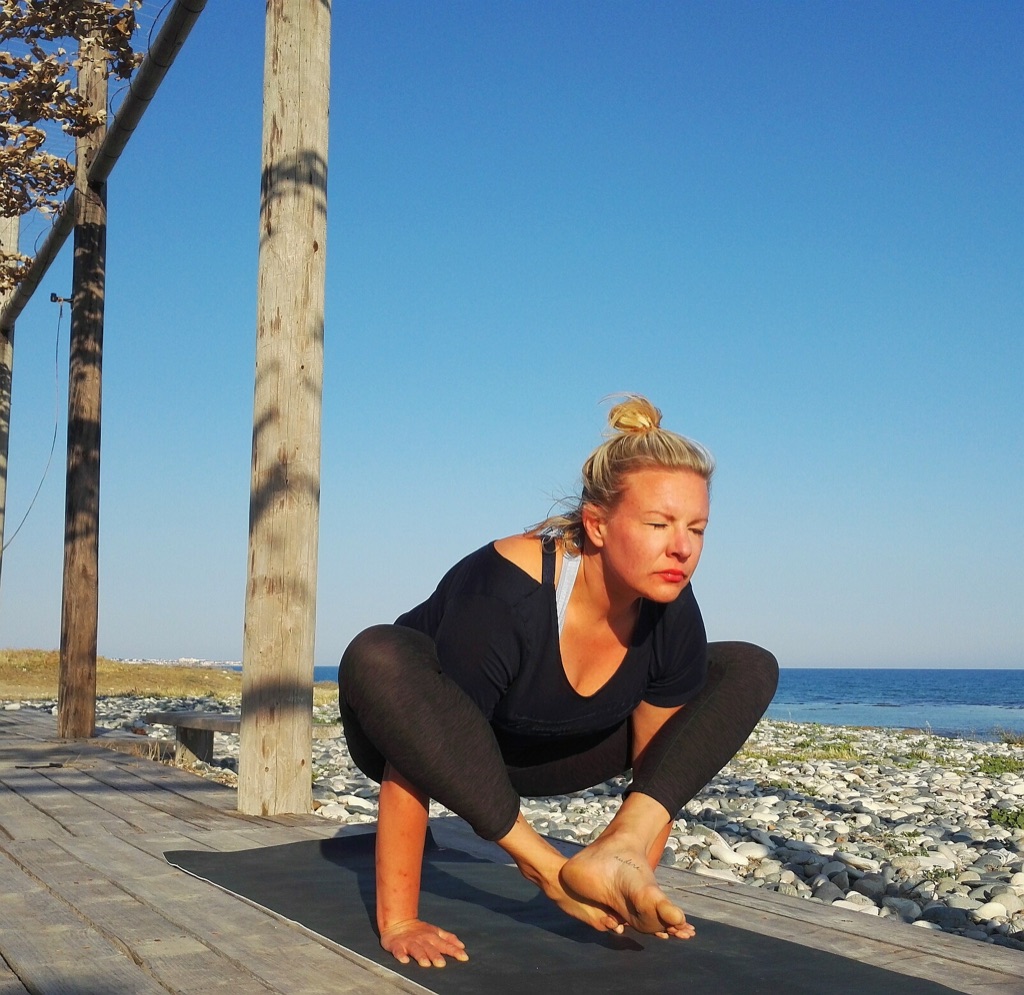
    Check out the focus on this Bhujapidasana…

    And that is the moment when the meaning of abhyasa and vairagya – practise and non-commitment – reveals its logic to us.

    To describe things as concisely as possible, abhyasa, as Patanjali explained them in his Yoga Sutras (Sutras 1.12 to 1.16), means to make consistent effort (i.e. practise), over time and even when do not feel like it (especially when we do not feel like it, some might say) to observe and follow thoughts, actions and general lifestyle choices that lead us towards a state of tranquillity. Why? Because this practise and the stilling of the mind it brings with it will help to reveal our true, “original” self, free from fears, stress, upsets and pain, all those things we so often feel our lives are filled with.

    By using the word ”effort”, this sutra reminds us that Yoga is not for the lazy. Nothing great was ever achieved without effort.

    – Reverend Jaganath Carrera

    Vairagya on the other hand can be understood as study or process of actively recognising, exploring and letting go of everything that stands in the way of finding inner peace and tranquillity. Put in other words, vairagya encourages us not to attach any significance on material wealth (clothes, cars, our latest phone…), non-material issues (situations that makes us agitated or angry, certain exam or career results, fancy yoga poses to be posted on Instagram) or anything else that may think of as important to us. Whilst we may fool ourselves to believe that obtaining more of wealth, recognition or whatever it is we crave for, it really just diverts us from finding inner peace and at the end is more likely to contribute to further unhappiness.

    Non-attachment is the cultivation of realistic, healthy relationships with objects and attainments based on understanding what the world can and cannot offer.

    – Reverend Jaganath Carrera

    It is of course hard to be conscious of the fact that we should not grow too attached of the outcome of our results, as after all this is very human. We might do well at work or with other projects, extremely well even and our efforts may even bring us material wealth or acknowledgement and we think we have the right to be proud of our hard work. And of course there is nothing wrong in those feelings. What we must be vary though is how we allow those attachments we have on desired results affect our mind and how we view ourselves in relation to our surroundings. Because equally, our efforts may not bring the success we wished for. How do we feel then? Do we get upset, do we feel our self-worth evaporating, do we feel we should have achieved more tangible results, feel more proud of our efforts?

    dav
    …which, regardless of the focus, can end up like this. 10 times in a row.

    In summary, abhyasa and vairagya remind us of the importance of consistent, daily and joyful practise, with a lifestyle and environment that support this, and how we must remain aware of our underlying motivations and expectations of this practise and aim to use it as a tool to experience peace that transcends external circumstance.

    And that requires constant, conscious effort. That’s why we call our yoga practise a practise in a first place.

    The blockquotes are from the sourcebook for Yoga Sutras I use – you can read more about the book here.

    Visibly a happy moment in practise.


    Tallenna

    Tallenna
    Tallenna
    Tallenna
    Tallenna
    Tallenna
    Tallenna