In all honestly up until few years ago I did not realise playing music in yoga classes was something that a) happens and b) is a preference for some. Now, I don’t mind either way. I sometimes practise at home with music on the background, and I have been to great yoga classes accompanied with well thought through music (think drum’n’base during a strong Jivamukti class at 7 am – it does wake you up!) For now I however choose not to use music in my classes and here is why:
It’s a distraction. I find it easier to guide thoughts internally and focus on listening my body when the main sound I can hear is my own breath.
There is already so much noise in this world and in our lives. Maybe this is a Finnish thing (we like our silence A LOT) but I really crave quiet time and want to offer that to the people who come to practise with me.
Curating soundtracks sounds like too much work. If I was to play music I’d like it to reflect the stages of the class: pranayama, creation of heat, peak pose… whatever the order of the day is. Which cannot always be dictaded in advance. And then what? Call me perfectionist, this just shows I DO take my music very (too?) seriously.
Music is a very emotive matter and you never know what memories a melody can bring up in people. The last thing you want is to play a tune that reminds somebody of their horrible break up or some other bad memory…
Over to you: music or no music during yoga class. What’s your preference and why?
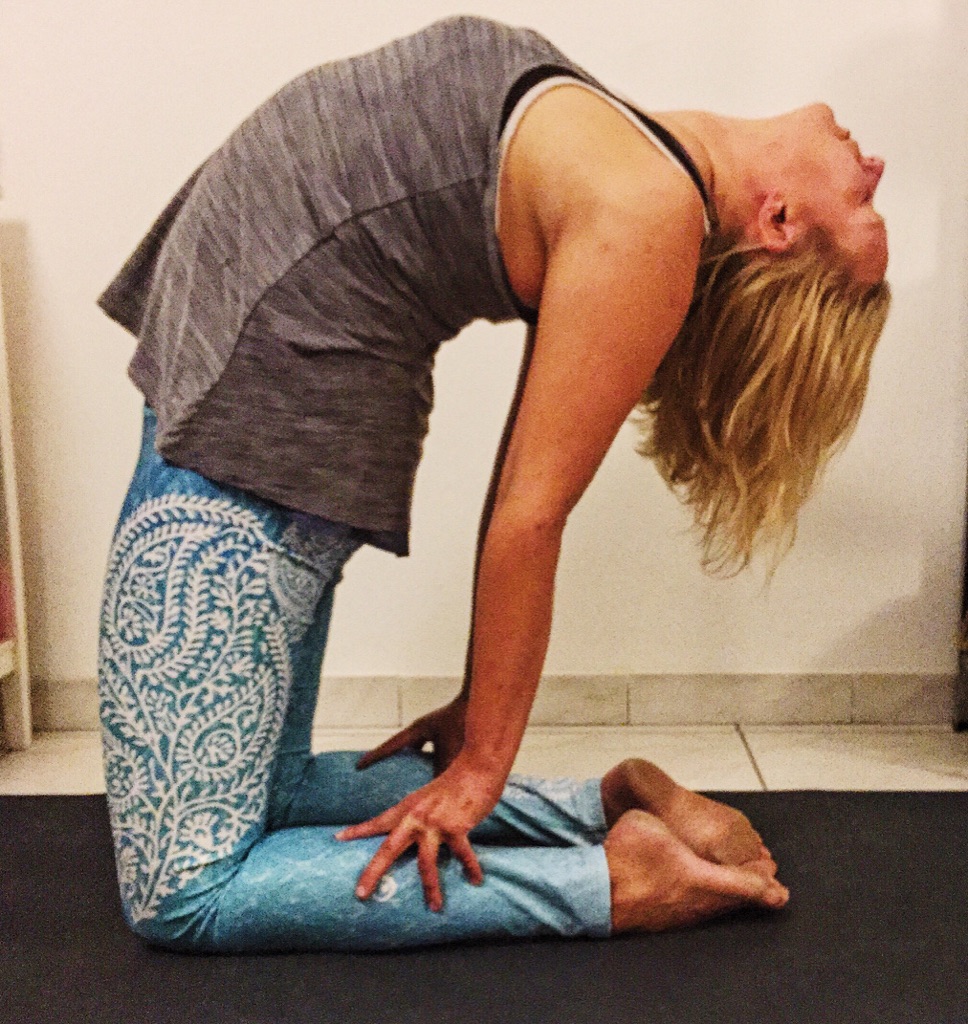
A really grainy picture but it is the better one I have of ustrasana/camel pose // Suttunen kuva mutta tässä kameli-asanan (?) linjaukset on paremmassa kunnossa kun siinä priimakuvassa.
Vielä muutama vuosi sitten en ajatellut että musiikki voisi olla joillekin tärkeä osa joogatuntia. Itseäni musiikki ei varsinaisesti haittaa (yleensä) ja kotona voi hyvinkin soida jotain taustalla harjoitellessani. Olen myös ollut tunneilla joissa musiikki on palvellut harjoitusta loistavasti: Drum’n’base kello seitsemältä aamulla voimakkaan Jivamukti-harjoituksen taustalla kyllä herättää päivään siinä missä pari kuppia kahviakin. Alla kuitenkin syitä miksi en tällä hetkellä soita musiikkia omilla tunneillani:
Se häiritsee keskittymistä. On helpompi hiljentyä ja keskittyä oman kehon tuntemuksiin kun isoin ääni salissa lähtee (ohjaajan lisäksi) omasta hengityksestä.
Elämä on jo muutenkin ääntä täynnä. Yleensä joka paikassa (jopa täällä maalla) on kaikenlaista taustamelua ihan tarpeeksi. Itse kaipaan usein hiljaisuutta ja haluan myös tarjota mahdollisimman hiljaisen ympäristön heille jotka tulevat harjoittelemaan kanssani.
Hyvän soundtrackin (puhumattakaan useamman) tekemiseen menisi varmaan hirveästi aikaa. Jos soittaisin musiikkia pitäisi sen sopia tempoltaan ja tunnelmaltaan tunnin eri osiin: Pranayama, lämmittely, pääasana… mitä sitten tunnilla tapahtuukaan. Jota ei voi aina etukäteen suunnitella. Ja mitäs sen musiikin kanssa sitten tekisi? Kuulostaa ehkä hieman täydellisyyden tavoittelulta mutta musiikki on vakava(hko) asia.
Musiikki on todella henkilökohtaista. Ikinä ei tiedä mitä assosioita ihmisille tulee mistäkin biisistä. Olisi kurjaa jos jostain kappaleesta tulisi jollekin mieleen ero tai joku muu ikävä muisto.
Mitäs mieltä te olette: musiikkia joogan taustalla vai ei?
Music during yoga class is a bit like wall stickers: Not everybody’s cup of tea. (I am still on the fence re: stickers. And did Mark Twain REALLY say those words in that order?) // Musiikki joogatunnilla on vähän kuin seinäkoristetarrat: kaikki ei tykkää. Itse en ole vielä päättänyt mitä mieltä olen tarroista, lähinnä tässä mietityttää että sanoiko Mark Twain todellakin juuri nuo sanat juuri tuossa järjestyksessä.
To practise yoga, you really do not need anything else but the willingness to be present in the now and the yoga mat as we know it is a rather new Western invention. However it can bring a new aspect to the practise by creating a space for your meditation and adding cushioning and stability for the asana.
These days there is a wide range of mats available, and the price range can be big. Therefore I decided to write about the mats I have used in my practise so far. The things I took into consideration are their grip (or slippiness), general durability, weight (important to those who travel or carry the mats with them a lot), cushioning and eco-friendliness. All my mats have measured more or less 185 x 61 centimetres although there are longer and wider mats available too.
The Basic Mat
What I call the Basic Mat is the mat that is the usually the cheapest one you can find. They all have more or less the same specs: Made of PVC (sometimes EVA, which is a lighter material), 2-5 millimetres thick and usually having a foamy ”grid” type of surface. You might want to buy the basic mat if you are new to yoga and not sure yet how much you can to commit to it. On the plus side these type of mats usually offer reasonable cushioning (if you have sore knees for example, go for a thicker mat) and they are easy to clean as both PVC and EVA are waterproof materials. At the same time they not the most durable ones, and tend to start shedding small pieces of plastic with the friction/elements the more you use them. They can also get slippy quite easily, especially if go to sweaty classes.
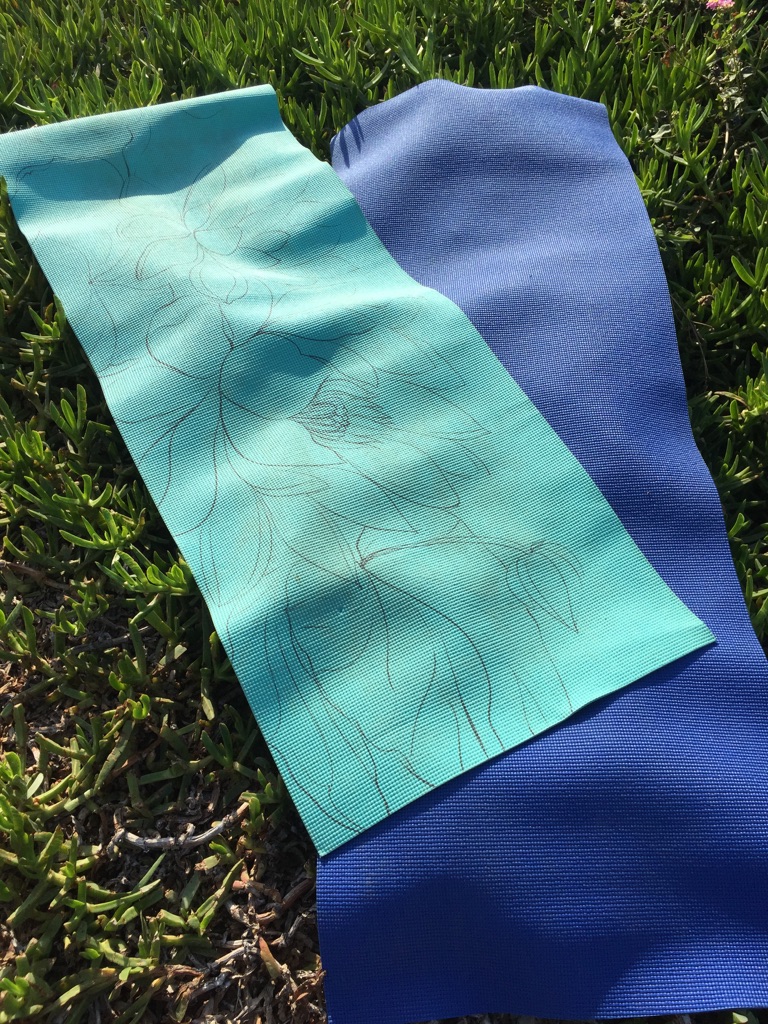
The Basic Mat. You see what I mean with the “grid”? The green one is from Lidl, the blue one I do not know. I call it the generic mat.
The price of the basic mat ranges usually from 10 to 30 euros, depending where you buy it and if it has some kind of brand label attached to it. I do not diss the basic mat as it will get you started just fine. If and when you have decided to commit to yoga more, here are some other mats I have used:
Drop of Mindfulness
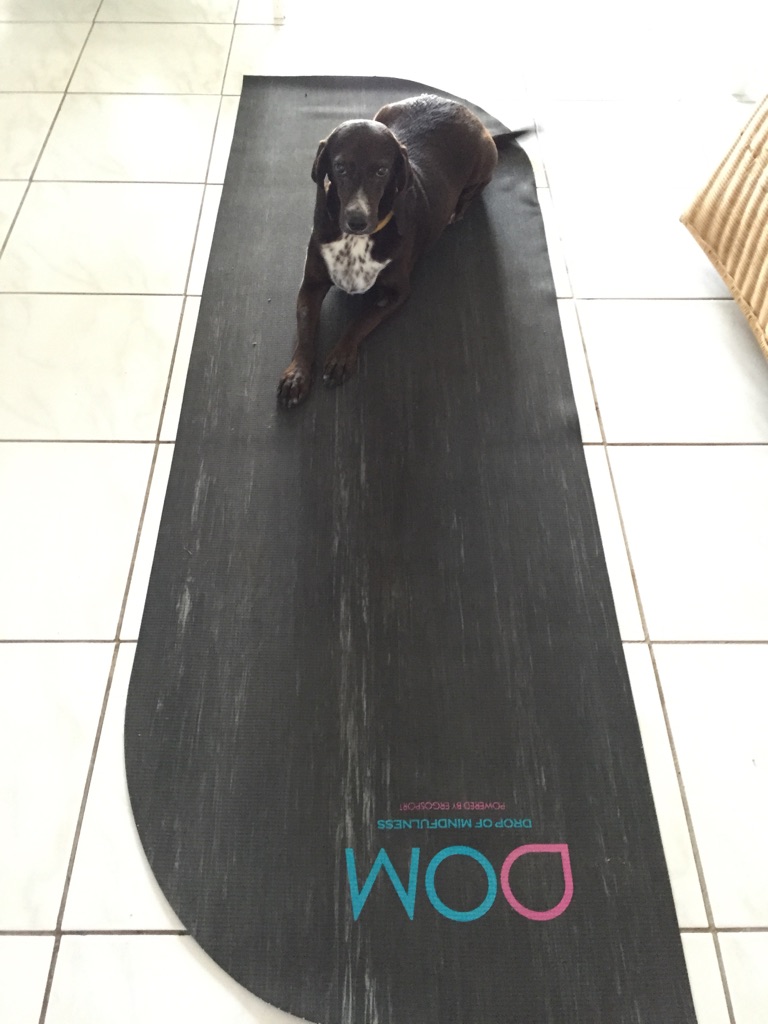
DoM is a Swedish brand that making active wear suitable for yoga and also yoga mats. Unfortunately at the time of writing this text their website is under construction for Winter 2016 so I cannot tell if they still stock the mat I bought 4-5 years ago. This mat has however served me very well; it felt very grippy and sticky straight from the start and has kept these qualities to this day. The mat is on the thinner side (I’d guess 2-3 millimetres) so extra cushioning is sometimes needed for knees. The weight is reasonable at around 2 kilos. I recall reading that the mat is made of natural rubber but this needs to be confirmed once the website is out again, together with the retail price.
“My Drop of Mindfulness mat. MINE!”
MandukaEKO
Manduka has a great reputation among yogis and they have several types of mats to choose from. I have the MandukaEKO (5 mm thick) which is extremely sturdy. When I stepped onto this mat after having used the DoP for years the difference was big: I need no extra cushioning needed for this mat and it does not fly away in the wind either (yes this can be an issue when teaching outside, hehe.) I have two cons for this mat though: It is heavy (over 3kg) so even if you travel with a proper suitcase, it does take a lot from the luggage allowance and it is definitely not a hand luggage item. The other thing is that it can get a little slippery, especially in sweaty conditions. The Manduka website says that this means the mat is not ”broken into” properly but I did not notice this in the beginning so not sure where the reason for this is. Nevertheless, this is a good mat and ecological choice as it is made of natural rubber with a zero waste manufacturing process. It is also 99% latex free.
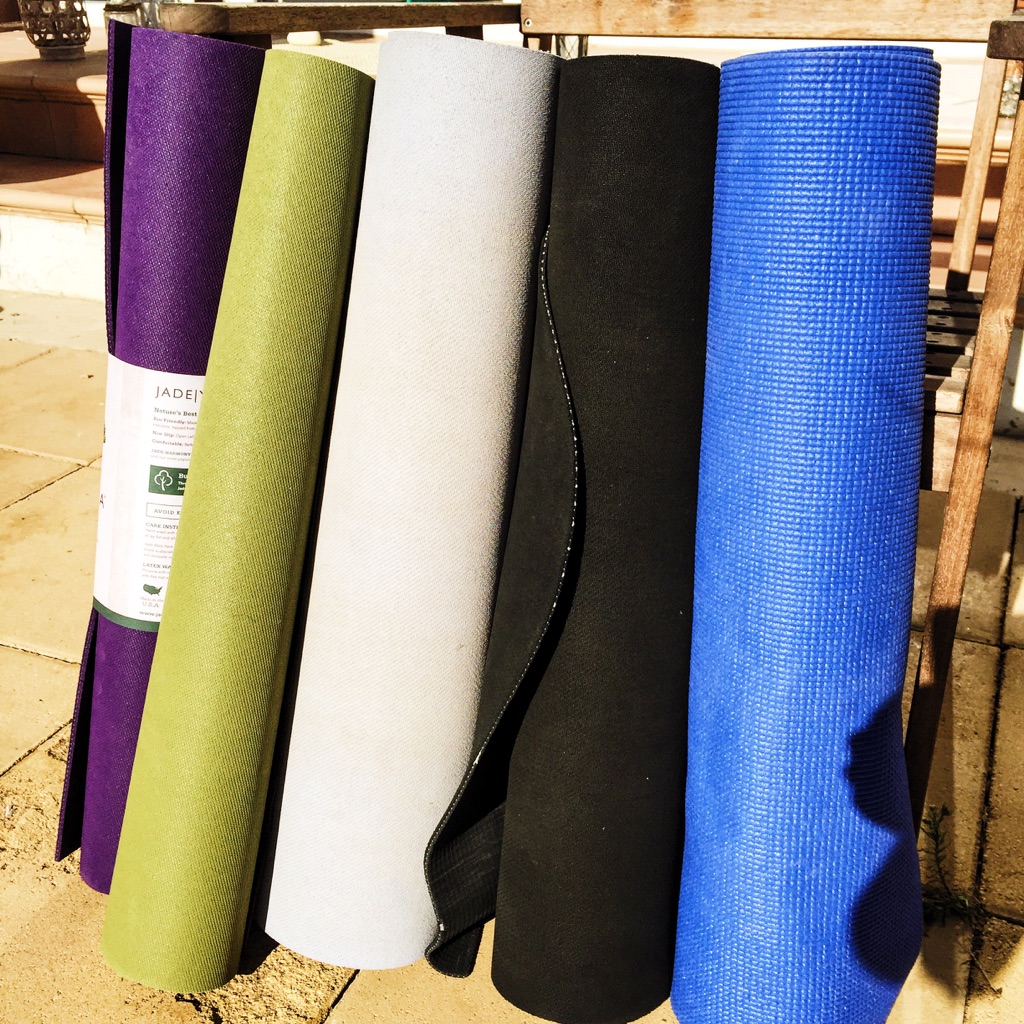
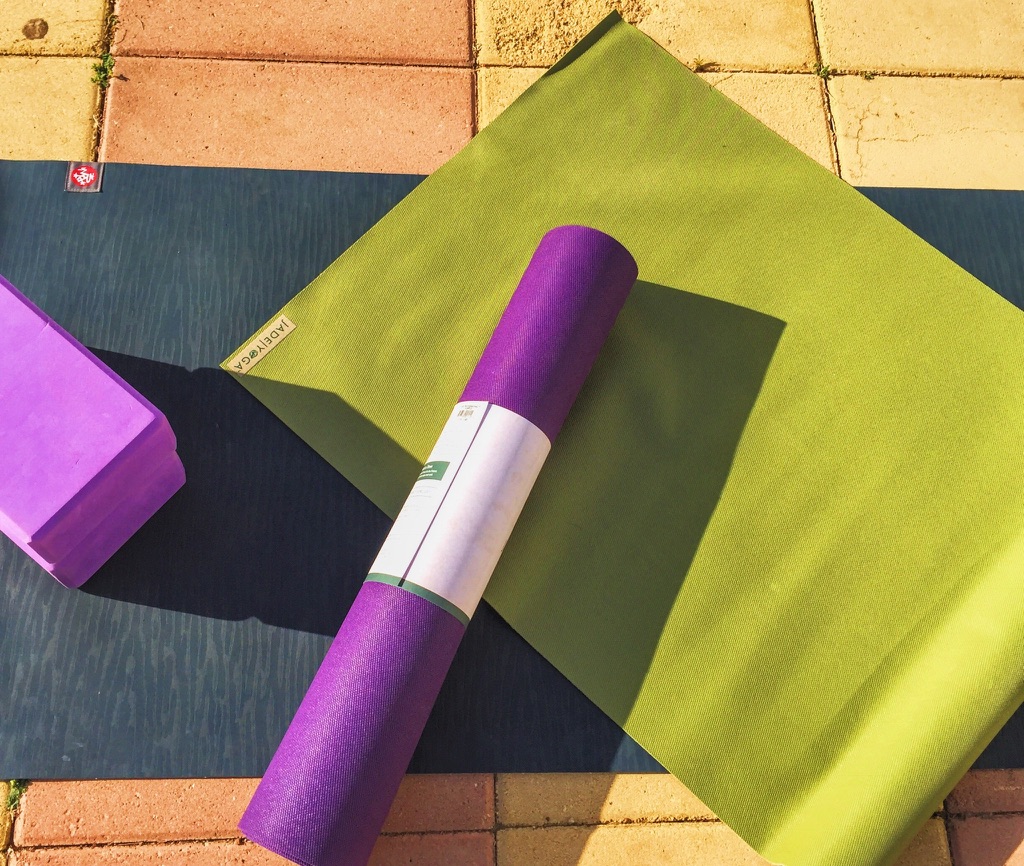
The MandukaEKO is the blue one at the bottom, notice the different texture. The purple one is the JadeHarmony and the green is JadeVoyager. The yoga blocks are just blocks although I could say few things about those too… Maybe later.
Jade Yoga Mats
JadeVoyager is my latest mat. I bought it from the MindBodySpirit festival in Nicosia last weekend. I’d been looking for a travel mat for myself for ages (airline luggage restrictions again!) Also my mum had sent me a photo of an ecomat she had seen in a magazine with the comment ”they don’t tell where I can buy one!” When I bumped into the lovely ladies from the Simply Green shop in Athens and saw the JadeYoga mats it they had it was a no brainer. I got the JadeVoyager for myself: you can fold it (rather than roll, although this is preferable for maintenance) and it weights just over half a kilo. With this weight it obviously has got no cushioning but it can definitely keep your practise going on when traveling. Orm you can use it over another, less grippy mat. For my Mum I got the JadeHarmony (Merry Christmas Mum, thanks for the gift tip!) which is about the same thickness than the MandukaEko. From the first touch it feels a bit softer and a lot more stickier. This can also be due to the open cell natural rubber JadeMats use (Manduka uses closed cell natural rubber) which translates as more grip, these ones will be put to test to find out more! The JadeYoga company also has a very eco-concious production cycle and they plant a tree (over one million so far!) for every mat sold.
From left to right: JadeHarmony, JadeVoyager,MandukaEko (mine is dark blue, you see the bottom side), Drop of Mindfulness and a Basic Mat in Blue.
When talking to fellow yogis and reading reviews the JadeMats are always rated on the top with Manduka ones. They both have very similar retail prices ranging from 40 (the travel mat) to 92 (the pro and extra long mats) euros so ultimately it is up to personal preference between these two.
Now, over to you: What is your favourite yoga mat?
I’ve been spending the last few days in London, making the most of the yoga classes the City has to offer. My goal was to try different classes and get inspiration from different teachers.
Olen viettänyt pari viimeistä päivää Lontoossa. Muiden asioiden hoitamisen lisäksi suunnitelmani on ollut käydä erilaisilla joogatunneilla ja inspiroitua erilaisita opettajista ja heidän tyyleistään.
A friend and a fellow yoga teacher in Cyprus recommended TriYoga so that has been my first stop. I LOVE their Camden location (there are 3 other locations in the city) which has a relaxed and complitely non-pretentous vibe in it. Even more, it has four or five yoga studios and a ton of classes to choose from. My first stop after five hour flight was “Restore and Relax” community class during which we did not stand up once. Perfect!
TriYogan tunteja suositeltiin minulle joten suuntasin suoraan lentokentältä heidän Camdenissä olevan studion tiloihin (TriYogalla on kolme muuta studiota eri puolilla Lontoota.) “Relax and Restore”-tunti oli juuri oikea viiden tunnin lennon jälkeen! Tunnilla ei noustu kertaakaan seisomaan vaan kaikki liikkeet tehtiin lattialla maaten.
The next day I tried out Jivamukti. I have been curious about the system but had not had an opportunity to try it out later. The teacher came recommended so 7:45 morning class it was! I really enjoyed it, we started off with 7 minutes of breathwork, followed by some chanting and a physical practise. The sequence was pretty intense for the morning but I got some hands on adjustments that I found good. The instructor also played drum’n’base during the asana practise and savasana which was a nice a chance to what I have been used to lately.
Seuraavana aamuna menin 7:45 alkavalle Jivamukti-joogatunnille. En ollut aiemmin kokeillut tämän suuntauksen joogaa joten olin innoissani uudesta kokemuksesta. Tunti alkoi 7 minuutin hengitysharjoituksilla jota seurasi mantran laulu. Itse asana-harjoitus oli intesiivinen varsinkin tuohon aikaan aamulla mutta erittäin hyvä. Opettaja kiersi luokassa ja paransi linjauksia tarpeen mukaan. Taustalla soi drum’n’base musiikki josta pidin myös. En yleensä käy tunneilla joilla on musiikkia (enkä sitä kyllä oikein kaipaakaan) joten tämä oli mukavaa vaihtelua.
I have also been observing few pregnancy yoga classes as this is a part of my ante natal yoga teacher training. Both teachers I contacted welcomed me with open arms to join in the class, much appreciated. The second class I attended was in this cute boutique gallery that runs different yoga classes also in the weekends.
Olen myös ollut seuraamassa muutamaa raskausajan joogatuntia joka kuuluu omaan antenatal-joogaopettajakoulutukseen. Opettajat joihin otin yhteyttä toivottivat minut kummatkin lämpimästi tervetulleeksi, on aina mukava saada positiivisia vastauksia pyyntöihinsä. Toinen tunneista pidettiin pienessä kauppa-galleriassa jossa on useita erilaisia joogatunteja iltaisin.
…and tomorrow there will be another new yoga class!
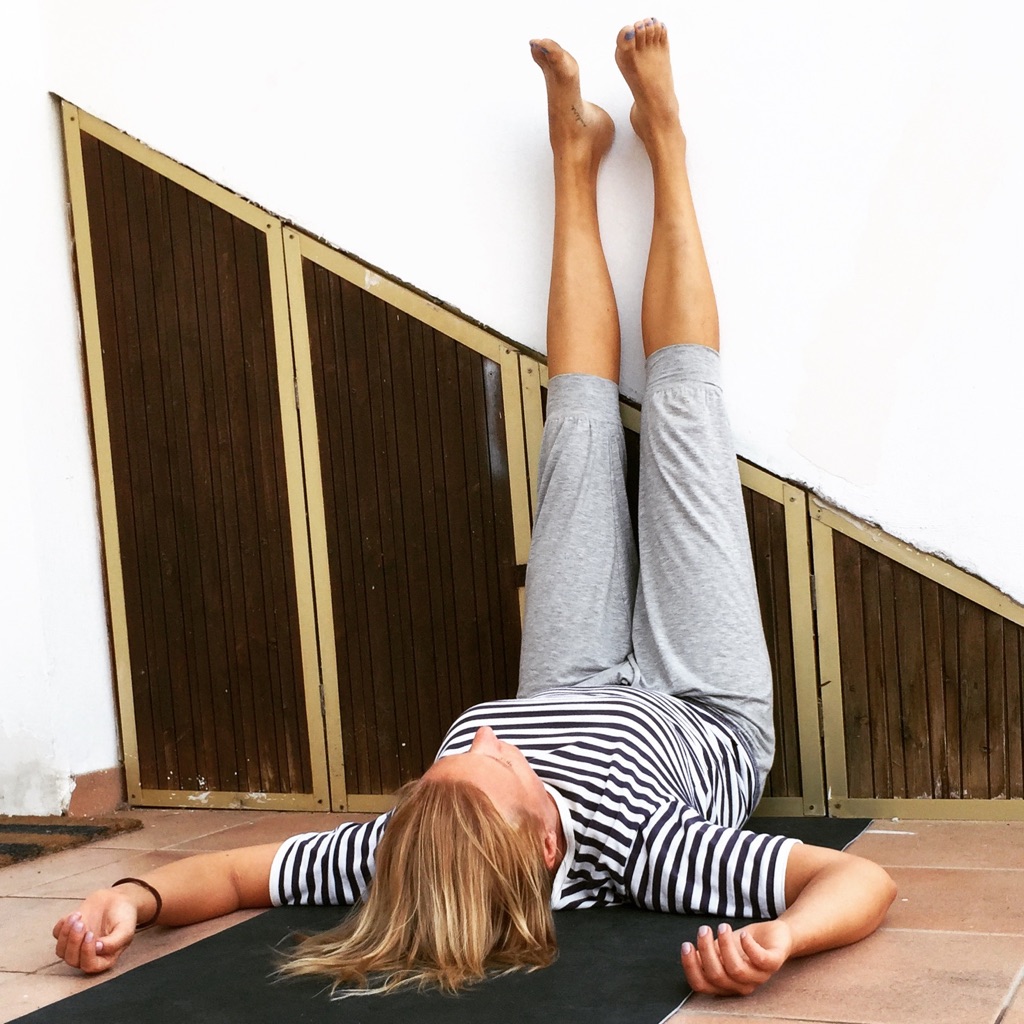
…and it’s a yoga pose! Legs-up-the-Wall-Pose, or Viparita Karani, is an asana favoured by many and no wonder as it is said to help with many different ailments, such as:
Anxiety
Arthritis
Digestive problems
Headache
High and low blood pressure
Insomnia
Migraine
Mild depression
Respiratory ailments
Urinary disorders
Varicose veins
Menstrual cramps
Premenstrual syndrome
Menopause
This pose is a restorative one, so in a yoga class you would find it usually right before the final relaxation. However it works just as well during a 10 break as a quick stress buster, or right before bed time. Practise with caution if you have neck or eye issues, always listening to your body first.
You do not have to get your butt right into the wall to grab the benefits, you can also do this pose with the soles of you feet against the wall.
Tässä vielä yksi jooga-asana jonka sanotaan auttavan sekä unen saamiseen että vähän kaikkeen muuhunkin, mm. ahdistukseen, reumaan, ruuansulatusvaivoihin, päänsärkyyn, korkeaan verenpaineeseen, migreeniin, virtsaamisongelmiin sekä vaihdevuosiin. Mulla ei ole aavistustakaan mikä tämän asennon nimi on suomeksi mutta tässä siis maataan selällään jalat seinää vasten. Jalat voi myös olla koukussa ja jalkapohjat seinää vasten jos ei halua pistää takamustaan suoraan seinään kiinni. Joogatunneilla tämän asennon löytää yleensä juuri ennen loppurentoutusta mutta tämän voi yhtä hyvin tehdä juuri ennen nukkumaan menoa tai jos on 10 minuutin pikarentoutusta vailla.
Jos kärsit niskakivuista tai silmänpaineongelmista, harjoittele tätä asanaa varoen.
Ystäväni kysyi minulta lisää linkkejä artikkeleihin jossa keskustellaan joogan hyödyistä, sekä niistä päänsisäisitä että fyysisitä. Kokosin eilen kasan englanninkielisiä linkkejä postaukseen. En suoraan sanoen uskonut löytäväni kovinkaan paljon suomenkielistä materiaalia jota en olisi jo käynyt lävitse mutta löytyihän niitä. Löytyi tosin paljon muutakin hämärää joogaan liittyvää mutta keskitytään nyt näihin tieteellisempiin linkkeihin.
Liinanblogissa on pari hyvää kirjoitusta joogan ja terveyden yhteyksistä, joissa kummassakin on lopussa viitteet lähdeaineistoon. Jutut löytyvät täältä ja täältä.
Yleisesti joogan fyysistä eduista voi lukea tästä. On syytä mainita että joogan vaikutusta fyysisen kunnon parantamiseen tutkivissa kokeissa on voitu käyttää joogan eri tyylejä, jonka takia tulokset liittyen varsinkin kunnon kohoamiseen ovat vaihtelevia. Uskon että on kuitenkin helppo ymmärtää että kahden tunnin ashtanga-harjoitus voi nostaa sykettä aika reippaasti. Ja jos et, tee tämä ja kerro miltä tuntui.
Mikä sitten on rasittavaa joogaa? Tämä artikkeli Kauneus ja Terveys-lehden sivuilta vastaa! Itse en ole käynyt Sivanda-joogassa, kaikki muut mainitut muodot ovat tuttuja.
Last week I wrote a piece about what yoga is (or can be.) I promised a follow up post on the benefits as well so here we go. You will not see flexibility on the list because it seems to be part of any other list of benefits/yoga discussion and I wanted to give space to all the other good stuff.
Before anything we have to do a small reality check: Yoga is not a miracle cure for anything. BUT, you can definitely start getting the benefits from the first class and a regular practise will help you to feel them on a deeper level. You will also not always eagerly skip and hop to every yoga class. Even long term practitioners have moments when they really have to drag themselves onto the mat. We want to be patient with yoga: it is as alive and evolving as everything else in life. But just consider this: Have you ever head anybody regretting going to yoga class?
To the point though. What’s there to gain?
Improved breath awarenes: We all know to how to breath, but there is a difference between breathing and breathing. In a yoga class you learn to focus on breathing with all your lungcapacity and lenghten your inhales and exhales. This in turn promotes the slowing of the heart rate, lowering of blood pressure and with this you get…
…lower stress levels!
Yoga moves your whole body: some poses move many different muscle groups, some just parts of your body. A yoga class is likely to be a combination of these micromovements and bigger ones, all contributing towards a…
…Improved body awareness. And awareness in general. Remember, you have started your class with breathing, calmed your mind so you are also more receptive to what is going on in your body.
Strenght building. This happens slowly but surely, as you work through the poses and hold them between 3-5 breaths.
Increased blood flow: Yoga poses together with the breath makes blood circulate better, bringing oxyganated to the cells. This in turn alleviates symptoms caused by poor circulation such as body fluid retention and/or swelling.
Improved immunity: Bluntly put, the breathing, twisting and getting in and out of poses you do in a class makes the fluids and organs inside us move, helping the lymphatic system to combat infections and to remove cellular waste.
Clarity of the mind, focus and relaxation: By know you understand that there is a lot going on during a yoga class, mostly on a subtle level. Your instructor will guide you with your poses and breathing, and after the final relaxation at the end you will feel lighter and rested…
Which means you will also enjoy a better sleep!
The list could go on and on… You can read more about the benefits here.
Let me know in the comments what benefits you have noticed coming up with your yoga practise?
When New York Times in January 2012 published an extract of William J. Broad’s upcoming book, titleing it ”How Yoga Can Wreck Your Body” it caused a big stir in the US. Although yoga injuries have always been around, until then they had remained unknown for the wider public yoga who associated practising yoga as something that heals and cures, not the opposite. The yoga community wrote several answers, most poking holes to Broad’s article and in defense of ”safety of yoga.”
Fast forward to 2016, yoga continues to grow and the discussion about the potential risks of the physical aspects of yoga has also evolved. Whilst Instagram would like us to believe that asana practise is very much about throwing shapes (and adding the odd sutra, or sutra-sounding, wisdom to go with it), there is also a growing awareness that in yoga one size might not fit all: We all come to yoga from different places, with different body types and abilities which need to be respected. Even more, the physical asana practise is just one of the eight limbs of yoga, and not the end on itself.
I have experienced myself what can happen when you take the mindfulnes out of yoga and get carried away with what seems like the fancy stuff. Having been taught how to do a headstand not in a particularly correct way in a very general open-class I continued to practise it more than needed and not with sufficient warm ups and preparations. As a result I now have a multilevel degenerative disk disease (discovered via a trip A&E, X-rays, neurological investigations including electric shocks and an MRI) in my cervical spine (i.e. the neck.) Now the only headstand I can do is with having blocks under my shoulders so there is absolutely no pressure on the top of my head or my neck. It’s ok and I take full responsibility for my state: After all, many yoga injuries do not occur on the spot but rather as a result of practising with an incorrect aligment for some time, even years.
My degenerated discs are somewhere here, between the C3 and C7. Photo by Heidi Marttinen.
The consensus these days is that whilst yoga-as-asana practise is not inherently any more dangerous or risky than any other physical activity, it is still exactly that: A physical activity. Just as you can roll over your ankle whilst washing up the dishes, you can roll over your ankle when on a yoga mat, and just like running with bad shoes can give you trouble after some time, so can doing an asana and not paying attention to how it is supposed to work with your anatomy. To practise safely it is important that we look out for a class and a teacher that we feel comfortable with and that suits our abilities. Most importantly, we must have the wisdom to back off from poses that we are unsure of, have patience with our practise and ask questions from your teacher.
A good link to read a bit more on the topic can be found in YogaJournal. I hope this text did not put off anybody from doing yoga as that was certainly not the intention. I do however feel this is a topic worthwhile acknowledging and having a think about. Practise safely and with a curious mind!
New York Time julkaisi tammikuussa 2012 luvun William J. Broadin seuraavassa kuussa julkaistavasta kirjasta otsikolla ”How Yoga Can Wreck Your Body” (Tämän voisi vaikka kääntää “Kuinka jooga pilaa kehosi”.) Artikkeli aiheutti kovan keskustelun varsinkin USAssa. Vaikka joogan aiheuttamat fyysiset vauriota on aina tapahtunut, suuri yleisö oli kuitenkin niistä tietämätön. Joogan harjoittaminen yhdistettiin vahvasti parantumiseen ja hyvinvointiin, ei vahingoittumiseen. Joogayhteisö vastasikin Broadin artikkeliin sankoin joukoin, lähinnä puolustaen joogan asemaa turvallisena harjoituksena.
Tähän päivään edetessämme joogan suosio on jatkanut kasvamistaan, mutta tietoisuus fyysisen harjoituksen mahdollisista riskeistä on myös laajentunut. Pikainen katsaus Instagramiin saa meidät helposti uskomaan asanan tarkoittavan lähinnä akrobaattisista asentoja joista suurin osa suoritetaan ylösalaisin ja joihin liitetään henkiseltä kuulostava sitaatti perään. Samaan aikaan käydään kuitenkin keskustelua kuinka ei ole vain yhtä ainoaa joogaa joka sopii kaikille yhtä hyvin: Me tulemme kaikki kuitenkin eri taustoista ja meillä on kaikilla erilaiset vartalot ja kyvyt joita on tärkeä kunnioittaa. Asana-harjoitus on myös vain yksi osa joogan kahdeksasta haarasta eikä siihen edes itsessään kuulu mitään “lopputulosta” johon tähdätä.
Olen myös itse oppinut kantapään kautta miten voi käydä jos fyysistä joogaa harjoittaa ajatukset harhaillen ja tekniikkaan keskittymättä. Minulla opetettiin päälläseisonnan tekniikka surffitunnin jälkeisellä kaikille tasoille avoimella joogatunnilla. Siitä innostuneena harjoitin sirsana- eli päälläseisonta-asanaa usein, myös ilman ehdottomasti tarpeellista lämmittelyä ja valmistavia asanoita. Tämän ”harjoittelun” tuloksena oli hitaasti alkanut mutta päivien sisällä täysin lamaannuttaneeksi vetänyt kipu joka ensiapuaseman, röntgenkuvien, neurologisten tutkimusten (ne sähköiskut…) ja magneettikuvauksen jälkeen paljastui niskan alueella olevaksi välilevyn rappeutumaksi. Nykyään minulle ainoa mahdollinen tapa suorittaa päälläseisontaa on pistää kolme joogablokkia kummallekin puolia hartioita niin, että päälakeni ei edes kosketa lattiaa. Kivut pysyvät hyvin poissa kunhan en tee ”vääriä” liikkeitä. Haluan painottaa että otan täyden vastuun omasta ajattelemattomasta harjoittelusta. Totuus on kuitenkin että monet joogavaurioista tapahtuvat pitkällä aikavälillä tapahtuvan harjoittelun seurauksena, ei yhden kerran tuloksena. Tämä tarkoittaa myös siis monia mahdollisuuksia tarkistaa että harjoitukset tehdään omalle vartalolle sopivassa linjauksessa, turvallisesti.
Tässä taas harjoitellaan olkapääleikkauksen jäljiltä, liikkuvuus oli vasemmassa kädessä todella huono melkein vuoden ajan. Jooga auttoi parantumisprosessissa fysioterapian lisäksi. Asanan nimi on kolmejalkainen alaspäin katsova koira, oikeassa asennossa molempien käsien pitäisi olla siis samassa linjassa edessä.
Tänä päivänä ollaankin laajasti sitä mieltä että asana-harjoitus ei itsessään yhtään sen vaarallisempaa kuin moni muukaan liikunta ja urheilu. Joogaaminen on kuitenkin liikuntaa jonka vuoksi sitä ei kuitenkaan pidä pitää itsessään riskittömänä. Turvallisen harjoittelun perustana onkin löytää itsellensä sopiva ja mukavalta tuntuva tunti ja opettaja joka osaa kiinnittää joogaajiin huomiota myös yksilöinä. Ehkäpä tärkeintä on kuitenkin tuntea itsemme ja omat rajamme: jos asana ei tunnu hyvältä on tärkeää uskoa omaa tuntemustaan ja olla tekemättä sitä, tai kysyä tunnin vetäjältä millaisia muunnoksia asanasta on tarjolla juuri sinulle. Jooga ei ole laji jossa pitää puskea harjoituksen lävitse hampaat irvessä tai pelokkaana.
Helsingin Sanomat kirjoitti joogassa tapahtuneista loukkantumisista hyvän artikkelin muutama vuosi taaksepäin, se löytyy täältä. Hyvä lyhyt englanninkielinen artikkeli aiheesta on taas täällä. Toivon että tämä teksti ei estä ihmisiä nauttimasta joogatunneistaan tai herätä turhaa pelkoa sillä se ei tietenkään ole tarkoitus. Koen asiasta kirjoittamisen kuitenkin tärkeäksi ja ajattelemisen arvoiseksi: Turvallinen ja kärsivällinen harjoittelu tuo joogasta ne parhaat puolet esille!
A chill image of the East Med to relax to // Rentouttava kuva kotinurkilta.
***Teksti suomeksi englannikielisen perässä *** Finnish text after the English one, hyperlinks to jump directly to the language you want coming up as soon as I get my head around the html***
In short, SUP yoga is yoga on a stand up paddle board, which in turn is not too different from a big surfboard. Over the years (the past four five to be exact) I have however noticed that whilst there is a lot of curiousity when it comes to SUP yoga, a lot of people are not really sure what it involves exactly. If you are one of those people, you are in the right place right now, as I am going to break it down for you.
Standing on A board and moving with the help of paddling has been around for thousands of years. The sport really came to the wider public consciouness in the mainland US, Europe and beyond 2010’s onwards and has since exploded expotentionally in popularity. Over the past 5-6 years yoga has also been taken on the board more widely and lessons are now available in many countries at least on a seasonal basis.
Few words about the SUP boards as there are different types around (and I am a boardgeek.) The best types for yoga are usually the ones categorised as ”all around boards. ” These are also the best for those interested in just casual paddling on mainly flat(-ish) waters and work just as well for complete beginners as they do for more advanced paddlers (or yogis.) The deck of the board (that is the space where you put your feet, or your knees, body, lie on your back, you got it…) should be flat, reasonably wide (anything 31’ to 36’ is common) and big in volume (say, from 150 litres upward). In general for boards, the bigger the volume, the better the floatation and the more weight it can bear. You can also get very good quality inflatable SUP boards that are suitable for yoga on the water. These days many countries also have a decent second hand market for boards that can be interesting to look at in case you are interested in purchasing your own board.
In this picture you have an all around board from Fanatic that is 10’6 long, 31′ wide and has the volume of 170l. The dog whose butt you see is unknown and if the sea looks like in the picture, you are better off going surfing with that board than to do yoga.
Before you get to buying a board you probably want to try out a class or few though: I have seen classes run on the Seas (like my Med) and Oceans in tourist resorts but also on lakes, rivers and swimming pools. In outdoor places the classes are usually run early in the mornings to guarantee flat water: here in Cyprus many places have the classes as early as 8 am due to the winds we can get later in the day. If I am leading a class, safety is always a priority so before anything else I want to check that people know how to swim (might see like an obvious question but hey… you never know) and are comfortable in water. It is also good to advise people how to fall onto the water and not to be too close to each others boards: in the instance of a wobble (part of the fun) you do not want to be falling on your own or your neighbours board. After this brief security check we’re ready to go on the water.
I have only done SUP yoga in the sea and have always used a sandback attached to the leash an as anchor (the leash is attached to the board on the other end of course.) To get to the water, each person grabs the board in one hand and the sandback on the other (in yoga you do not need the paddle at all), places the bag on the board and lying on stomach paddles out to a spot indicated by the instructor. You then drop the anchor down and wait to float you to the perfect position. After that your instructor chooses his/her spot in front of everybody and off you go. I have also seen places where they have a type of a deck to park the SUPs to stay in position but I have never done a class in such a spot.
Because SUP yoga has an inherent element on instability (the water moves, no matter how flat it is) I sequence my classes differently than I do for on-land classes. Of course, if you are an advanced yoga practioner and have a great balance I cannot think of an asana you could NOT do in the water. However, for a nice all-around class I choose carefully the standing asanas I have for instance: It is ok to fall into the water few times but that is all you are doing during your class, it is probably not what you signed up for. Most seated and supine poses are great though and nothing beats savasana on the water.
The wheel pose (urdhva dhanurasana) on a board. You want to be very comfortable with this pose on dry land before attempting this one. The photo credit goes to the crew at WindsurfCityCyprus.
Truth to be said, I do sometimes wonder how much actual yoga there is in SUP yoga. For many, water is the ultimate meditative space so I do get the bliss feeling that is associated both with yoga and water. Still, SUP yoga for me is a nice extra, something to mix things up a little bit but it does not substitute my proper practise on a mat. If SUP yoga is your first experience with anything yoga related I do encourage you to go and try a regular class as well as the experience is different.
Have you tried SUP yoga yet? What did you think and how does it compare to an off-water yoga class for you?
Lyhyesti kuvailtuna SUP jooga on joogaa jossa harjoitus tehdään surffilautaa muistuttavalla kelluvalla laudalla. Vuosien (ainakin viimeisen neljän-viiden) varrella olen huomannut että vaikka SUPjoogasta puhutaan paljon ja se kiinnostaa ihmisiä, moni ei kuitenkaan ole ihan varma mitä se itse asiassa on ja mitä tunnilla tapahtuu. Jos kuulut tähän jälkimmäiseen ryhmään tämä teksti toivottavasti tarjoaa vastauksia.
Jonkinnäköistä laudalla seisomista ja sen liikuttamista melan avulla on harrastettu tuhansia vuosia. Laajempaan tietoisuuteen Hawaii’in ulkopuolella suppaus on kuitenkin tullut 2000-luvun aikana ja varsinkin viime vuosina sen suosio on räjähtänyt. Joogaa laudan päällä on harrastettu ainakin viimeiset 5-6 vuotta laajemmin ja nykyään SUP joogaa on hyvinkin laajasti tarjolla ainakin kesäkausina.
Pari sanaa SUP laudoista koska niitä on hyvinkin erilaisia saatavilla mikä saattaa olla hämäävää. Parhaat laudat joogaa varten löytyy yleensä ”yleis” (all around) laudoista jotka soveltuvat rentoon melomiseen lähinnä tyynillä vesistöillä, ja tukevuutensa ansioista käyvät eritasoisille ja –kokoisille suppailijoille. Yleisesti puhuen on tärkeää on että laudan pinta on tasainen, noin 73 – 91 senttiä leveä ja tilavuudeltansa noin 150 litrasta ylöspäin. Mitä enemmän laudasta löytyy tilavuutta litroissa, sitä parempi on sen kelluvuus ja sitä enemmän se kestää painoa. Myös pumpattavista SUP laudoista löytyy paljon joogaan soveltuvia yksilöitä. Lautoja löytyy nykyään myös jonkin verran käytettyinä ja näitä kannattaa bongailla myöskin jos oman laudan osto kiinnostaa.
All-around laudalla (kuvassa mennään tosin pienemmällä wave SUP laudalla…) voi myös surffata pienissä aalloissa. Muista tyyli ja turvallisuus kaatuessa.
Ennen oman laudan ostoa ainakin joogaa varten kannattaa tietenkin kokeilla muutamaa tuntia. SUP jooga tunteja järjestetään merialuilla (niin Väli- kuin Itämerellä), monissa turistipaikoissa, vesillä (esim. Tampereella Pyhä- ja Kaukajärvillä), joissa ja jopa uima-altaissa. Ulkotiloissa tunnit ovat usein aamuisin varsinkin tuulille avoimissa paikoissa: Kyproksella tunnit pidetään usein aamukahdeksalta sillä jo 9-10 aikaan voi tuulet tehdä tunnista ei-niin-rentouttavan kokemuksen. Turvallisuus on itselleni aina se tärkein asia joten ennen tuntia varmistan että osallistujat osaavat uida (tyhmät kysymykset ovat joskus ne tärkeimmät…) ja keneltäkään ei löydy vesikammoisuutta. Neuvon aina myös kuinka laudalta keikahdetaan turvallisesti pois, ja mikä on sopiva turvaväli joka kannattaa pitää muihin. Vaikka veteen tippuminen kuuluu asiaan kukaan ei halua kaatua oman tai naapurin laudan päälle. Vasta briiffin jälkeen menemme veteen.
Itse olen harrastunut ja ohjannut SUP joogaa ainoastaan merialueilla ja käyttänyt hiekkasäkkiä ankkurina joogatunnilla. Veteen mennään lauta toisessa kädessä ja hiekkasäkki karkuriremmiin kiinnitettynä toisessa kädessä (remmi on siis toisesta päästä kiinni laudassa.) Veteen päästessä säkki pistetään laudalle jonka jälkeen melotaan käsin laudalla mahallaan maaten ohjaajan osoittamaan paikkaan. Hiekkasäkki tönätään laudalta alas ja odotetaan että lauta asettuu paikalleen. Tämän jälkeen ohjaaja (yrittää) löytää paikkansa osallistujien edestä ja tunti voi alkaa. Olen myös nähnyt kuvia paikoista joissa SUP joogaa varten on rakennettu laiturimainen ”parkki” laudoille jossa ne pysyvät paikallaan.
Elina on a SUP yoga without a fin
SUP joogaan kuuluu luonnollisena osana tietty tasapainottomuus koska tyynikin vesi liikkuu usein laudan alla. Omille tunneilleni rakennankin harjoituksen eritavalla kuin maalla pidettäville tunneille. Hyvän tasapainon omaavaa joogaaja voi varmasti tehdä asanan kuin asanan laudalla turvallisesti. Tunneilla on kuitenkin usein hyvinkin eritasoisia joogaajia ja vaikka veteen tipahtaminen voi olla hauska kokemus kerran tai kaksi, kukaan tuskin haluaan laudalle kampeamisesta tunnin pääteema. Tämän takia käytän esimerkiksi seisovaltaan tehtäviä harjoituksia vähemmän, keskittyen istuviltaan tai selällään maaten tehtäviin asanoihin enemmän. Loppurentoutus vedessä on myös upea kokemus.
Suoraan sanoen olen useamman kerran miettinyt onko SUP joogaamisella mitään tekemistä varsinaisen joogan kanssa. Vesi voi olla todella meditatiivinen elementti joten ymmärrän kuinka jooga ja vesi menevät hyvin käsi kädessä ideatasolla. Itselleni SUPjooga ei kuitenkaan korvaa maalla tehtävää harjoitusta vaan toimii lähinnä erikoisuutena joka on hauska tehdä silloin tällöin. Jos laudalla tehtävä jooga onkin ensimmäinen kosketus joogaamiseen suosittelen lämpimästi myös ”oikealla” joogatunnilla käymistä.
Oletko sinä jo kokeillut SUPjoogaa? Mitä ajattelet tunnista ja voiko kokemusta verrata muihin joogatunteihin?
I had a chat about yoga books with a friend yesterday and this old post of mine came to mindf. As nothing has changed since I first published this text, here you go again: some of my favourite yoga books.
Yoga books are nothing new. The first systematic presentation of yoga in a written form, the Yoga Sutras by Patjanhali is said to dated circa 400 CE (I am aware there is debate around this date but I am not going to dwell any deeper into it), whilst another renowed yogic scripture, the Bhagavad Gita dates an estimated 500 BCE.
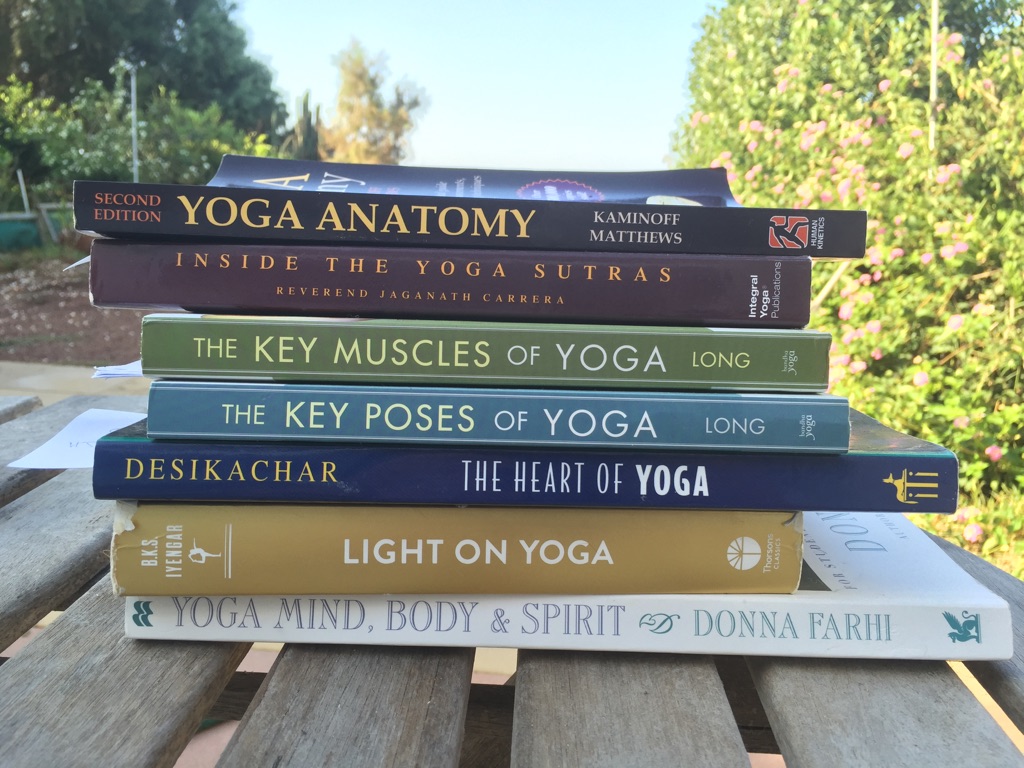
There is a ton of yoga books around and it can be hard to pick just one or two. Here’s a list of some of my favourites. Some of these I read almost every day, some less so but they have all served a purpose of some sort in my yoga studies. If the list looks familiar it is because each one of the books is on the Amazon’s ”Top 15 or so Yoga books” list and many are teacher trainer reading staples. Hence expect nothing crazy original but if you are newer to yoga literature this might be helpful.
A lot of people approach yoga through the physical practise. I would however encourage any student of yoga to have a look at what lies in the roots on the asana practise. A good place to start is the Yoga Sutras of Patanjali. These are the basic teachings of yoga are described in short verses called sutras, which are organised in four padas, or chapters. As reading a direct Sanskrit translation might seem a daunting task, there are luckily many text books offering an approachable commentary and interpretation of the sutras in a easy-to-digest form. The text book I have is authored by Reverend Jaganath Carrera and it is called ”Inside The Yoga Sutras.”
Several books combine philosphy, breathing technique and asana practise in one. A classic is B.S.K Iyengar’s ”Light on Yoga – The Definitive Guide to Yoga Practise.” The books has fantastic black and white photo illustration and the descriptions on how to get into each pose are very detailed. On a complitely superficial level, the 2015 edition I have is also beautiful to look at. The only minus comes from it being a very heavy for a paperback so it is not the best travel read.
Donna Farhi’s ”Yoga Mind, Body & Spirit – A Return to Wholeness” is another very complete book. In all honestly I found this one a bit hard going BUT it offers very wide margins for your own notes as you go along. The illustrations and photos are very clear and I like that the use of props, such as chairs, blankets and blocks, is incorporated to offer different types of modifications.
My favourite book on this list is probably T.K.V. Desikachar’s ”The Heart of Yoga – Developing a Personal Practise.” Written in a conversational manner (in fact, part of the book is in an interview Q & A format) the book is a practical approach to various elements of yoga: asanas, breathing and meditation. It also has a chapter on the Yoga Sutra’s with Desikachar’s own translations and comments.
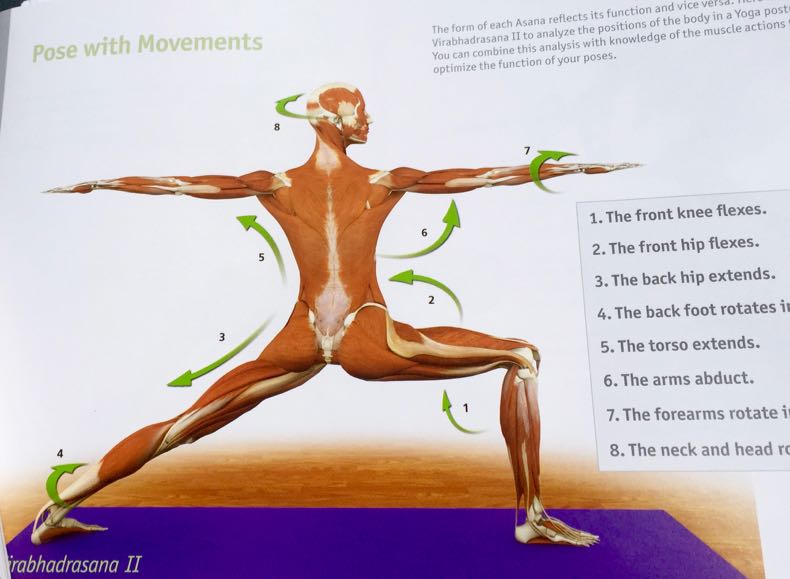
There are of course plenty of books focusing solely on the anatomy side of yoga. Leslie Kaminoff & Amy Matthews’ ”Yoga Anatomy” (I have the second revised edition) is the one of the most recommended ones. In every page it offers a clear illustration of inside the asana (see the photo to get an idea), a classification, actions for joints and muscules, a word about the respiratory mechanism applicable to that pose and additional notes. A perfect go-to book when you want to check how your body works in a given asana, I use this book several times a week.
I also have two books of Dr. Ray Long, ”The Key Muscles of Yoga” and ”The Key Poses of Yoga.” I must admit that I first got excited by these books due to the big illustrations that take up most of the pages. Anatomy can be difficult and the pictures make it more approachable! I find these books (unlike the ones listed before) are also usable during actual practise due to simple layout.
What are the yoga related books you have read and would recommend?