Category: Yoga Philosophy and Mindfulness

About The Yoga Sutras and other ponderings.

  • Jooganidra lyhyesti

    Jooganidra lyhyesti

    Jooganidra, tai jooginen unennäkö joksi sitä myös kutsutaan, on olennainen osa joogaperinnettä ja sen moninaisia muotoja. Jooganidra on meditatiivinen harjoitus, ja se sopii useimmille ihmisille riippumatta heidän fyysisetä kunnostaan tai aiemmasta joogataustasta. Jooga nidra ei kuitenkaan ole yhtä laajasti tunnettu harjoitus kuin esimerkiksi joogan fyysisemmät muodot, vaikka siinä ei ole kyse mistään mystisestä.

    Lue alta lyhyesti mistä kaikesta jooganidrasta on kysymys.

    Tietoisen levon harjoitus

    Jooganidra on tietoisen levon harjoitus jossa tarkoituksena ei ole nukahtaa, vaikka näinkin voi rehellisyyden nimissä käydä. Harjoituksen päämäärä on saavuttaa syvän tietoisuuden tila, jossa on mahdollista olla samaan aikaan sekä levossa että tietoinen tämän levon eri tasoista. Jooganidra noudattaa tiettyjä tuhansia vuosia vanhoja lainalaisuuksia jotka ovat kuitenkin niin joustavia, että ajallisesti nidraharjoitus voi kestää mitä tahansa kymmenestä minuutista yli tuntiin.  Osaavan vetäjän käsissä jooganidra antaa harjoittajalle mahdollisuuden tuntea täydellinen fyysinen, henkinen ja emotionaalinen rentoutuminen.

    Istuen tai makuuasennossa

    Jooganidra-harjoitus voidaan tehdä makuuasennossa tai istumalla, sen mukaan mikä sillä hetkellä tuntuu parhaalta. Nidran voi tehdä yhtä hyvin työvaatteissa kuin verkkareissakin. Tärkeintä on, että harjoittelijalla on mukava ja turvallinen olo, sopivan lämpöisessä tilassa, jossa ei ole ylimääräisiä häiriötekijöitä.

    Tieteellisesti todistettu toimivuus

    Tieteellisissä tutkimuksissa jooganidran on osoitettu rauhoittavan hermostoa, parantavan verenpainetta sekä tasapainottavan kehon hormoonitiloja. Jooganidra voi myös olla erittäin miellyttävä ja kokonaisvaltiasta rauhanoloa edistävä kokemus esimerkiksi ahdistusta, masennusta ja/tai erilaisista stressihäiriöstä kärsiville.  

    Lyhyen tai pitkän kaavan kautta

    Ei aikaa? Ei hätää! Jooganidra-harjoitus voidaan tehdä itsenäisenä kokonaisuutena, mihin päivän aikaan tahansa. Voit kuunnella nidra-äänityksen sängyssä heti herättyäsi, tehdä 30 minuutin mittaisen harjoituksen lounastauon aikana, tai nauttia siitä hikiseen Vinyasa Flow tunnin jälkeen. Suurin osa jooganidran koulukunnista noudattaa melko samanlaisia ​​rakenteita. Tämä tarkoittaa, että harjoittelu on erittäin mukautuvaa ja se toimii yhtä hyvin riippumatta sen pituudesta.

    Kiinnostaisiko sinua kokeilla?

    Kiinnostaako jooganidran kokeilu? Harjoituksia löytyy paljon ilmaisina tallenteina. Omiin suosikkeihini kuuluvat Yoga Nidra Network – sivun sekä Insight Timer – sovelluksen lukemattomat tallenteet. Löydät nidroja myös myös YouTubesta. Harjoitusta ei voi tehdä väärin, joten voit aloittaa helposti hakemalla haluamasi pituisen harjoituksen ja käymällä mukavaan asentoon ja antamalla mennä – tai siis olla. Anna äänen johdattaa sinut rentoutukseen ja nauti.

    Tällä viikolla (kesäkuun ensimmäisellä viikolla) sisällytän myös jooganidran kaikkiin 60 minuutin harjoitteluuni. Itse en käytä valmiita tekstejä joten jokainen nidra tällä viikolla (ja muutenkin) on erilainen ja tilanteeseen sopiva. Olisi ilo tavata sinut Zoom-tunnilla, tämän viikon tunnit näet tämän linkin takaa.

  • Yoga Nidra Explained in 5 Points

    Yoga Nidra Explained in 5 Points

    Yoga Nidra, or the Yogic Sleep, is an integral part of the Art and Sciences of Yoga. One of the most accessible ways of practicing yoga, Yoga Nidra is not necessarily the most well known one. Read here briefly what it is all about, in 5 points. 

    Yoga Nidra translates as “Yogic Sleep”

    Yoga Nidra, or the Yogic Sleep as can be described, is a technique of achieving a state of conscious rest. It follows a specific format that can take anything between 10 to 90 minutes. During the practice of Nidra, the practitioner appears to be asleep, but maintains a consciousness at a deeper level of awareness. Yoga Nidra is always guided, and in expert hands can allow for the practitioner to feel complete physical, mental and emotional relaxation.

    A non-physical practice, it is suitable for most individuals

    Yoga Nidra can be practiced lying down or seated, in any type of clothing, and regardless of one’s physical ability. The main thing is to have a set up that feels comfortable, safe, and free of distractions.

    Scientifically proven health benefits

    In several studies Yoga Nidra has been proven to calm the nervous system, improve blood pressure, heart rate variables and hormone irregularities. It can also be an incredibly soothing experience for those suffering from anxiety, depression and PTSD, to name but few.

    Yoga Nidra does not require a lot of time

    Not much time? No problem! Yoga Nidra can be practised as a standalone method, and at any point of the day. You can listen to a Nidra recording in your bed first thing after waking up, do a 30 minute one during your lunch break, or enjoy it as an addition to your sweaty Vinyasa Flow. Most Schools of Yoga Nidra follow reasonably similar structures. This means the practice is highly adaptable and works just as well, regardless its length.

    Can be practised by listening to a recording, or in a live setting

    Interested in trying out this practice? There are plenty of very good recorded and free resources: My favourites include the recording as Yoga Nidra Network page, and those you can find on the Insight Timer app. You can also find them on YouTube. There is no wrong way of doing a Yoga Nidra so you can easily start by picking up one and moving on from there and discover if you have preferences: Female voice, male voice, with or without soundscape in the background… There are several different types of Nidra available.

    Twice a week I teach a 60 minute Restorative Yoga and Yoga Nidra class on Vivaya Live. The Friday class is at 17:00 BST, and the Sunday class is at 18:00 BST. Drop ins are welcome, you can book your spot from here.

  • Simple Mindfulness Exercises for Every Day – Part 2

    Simple Mindfulness Exercises for Every Day – Part 2

    Few days ago I shared in this post few simple Mindfulness Exercises you can easily incorporate in our daily lives. The practises given were more about bringing the attention in the “externals” of the moment, through focusing on outside sounds and the physical body. The next two exercises are more about finding the “being in the now” through focusing on the internal.

    As in the previous exercises, find a comfortable a seated position, on the floor or on a chair. Lying on a yoga mat is also an option but if you choose this, try not to fall asleep during your practise. You can choose any location where you feel comfortable to soften your gaze, or even close your eyes. Breath as you feel the most relaxed: Lengthening your inhales and exhales is always an option but if this does not feel comfortable or seems to take your main focus, just breath normally.

    Notes to Strangers about Mindfulness
    Internal Scan

    Sometimes called the Mindful Check-In, the aim of this practise is to pause to check in how you are REALLY feeling at a present moment and acknowledging what is there. You might notice some physical sensations whilst starting to check in, such as tension, dullness or tingling. Start paying attention to your state of mind, the emotions that arise and notice them without any judgement. It is absolutely ok to notice feelings of frustration, irritation or even anger, or feeling sad and tired. Do not try to chase emotions that we might classify as “negative”, just notice them and acknowledge them. It might feel silly but you can try saying hello to them in your mind, and then just let them go, observing what comes up next.

    Eventually you might be able to notice how many layers of emotions. For instance, there is a saying “angry is the bodyguard of sad.” So maybe, underneath the irritation or anger there are feelings of having been let down or disappointment. In a longer practise, acknowledgment of the feelings and noticing the underlying currents can help us to create a distance with ourselves and our thoughts and emotions. This is turn will help not to get caught up and owned by our feelings, as we start to understand where they arise and learn to create a moment of stillness when we need it. Be generous and kind with yourself: Mindfulness is about taking care of yourself and honouring what is within you at a given time. 

    Notes to stranger
    Observing The Psychological Time

    Psychological time, as opposite to clock time, can be described as the time that occurs in the brain, as the thinking mind projects to the past or to the future. Whilst it is natural for the mind to wonder outside the present moment, we should be aware of not being over consumed by the past or the present on the expense of what we are experiencing in the moment. For instance, many of us have found ourselves in holidays, starting to think how wonderful things are and how we wish that holidays would last forever. This line of thinking can however easily turn into negative thoughts about how it will be to return to work and to our normal routine. Rather than enjoying the moment, we are allowing the future – over which we have no control nor knowledge how it is going to turn out – to steal from the current moment and from the experiences we could be having.

    Another example of getting caught up in the highly subjective psychological time is to let past events and/or emotions – both of which we cannot do anything about anymore – take excessive amount of time from the present moment. Whatever the past incidents might be, the only thing we can do about them is to acknowledge them, make peace with them and let them go.

    The observing the psychological time practise helps us to increase self-awareness and to learn how to be more focused and fulfilled in the moment. Lying down or seated, start noticing where your thoughts are going, again with no judgement. Do you notice your mind wondering more to the past events, or to the future? Do you notice finding yourself going back (or forward) to the same moment, or moments have a similar theme? Gently acknowledge the psychological time of your thoughts and see if you can guide yourself back to the present moment, without any need to start trying to figure things our right now – that can always take place later. Take your time and accept the emotions that might surface.

    As with all the mindfulness exercises in this post and the previous, allow yourself few minutes to come around gently. If you practise with eyes closed, gently open your eyes, maybe stretch your body a little bit, scrunch your face, take few conscious inhales and exhales. Acknowledge and thank yourself for your willingness to be present in the practise. Regardless of any feeling of how you think your practise went, recognise and congratulate the fact that you with any one of these practises you are contributing towards your well-being.

    Notes to strangers
  • Simple Mindfulness Exercises for Every Day

    Simple Mindfulness Exercises for Every Day

    Over the last few years Mindfulness has become to the awareness of general public internationally, although its roots can be traced thousands of years back. But what is Mindfulness exactly and how do you exercise it?

    A useful definition of Mindfulness comes from Dr Jon Kabat-Zinn who developed his first stress-reduction programme in the 70s. He regards the practise as “the awareness that arises through paying attention, on purpose, in the present moment, non-judgementally, and in the service of self-understanding and wisdom.”

    In other words, mindfulness practises aim to bring our focus more to the now, rather than be occupied by the past and/or the present. This helps us to adjust the ways we experience and appreciate the world around us, and not to get caught up and consumed by something we cannot have any influence over.

    Mindfulness is often practised in a seated position, on the floor or on a comfortable chair. Lying on a yoga mat is also an option but if you choose this, try not to fall asleep during your practise. There are also other alternatives, such as walking meditations in the nature that can make practising mindfulness more approachable.

    In this post and the next I am sharing four simple mindfulness exercises. Some of you might be familiar with one or several of them as especially the body scan is often used in yoga classes. You can practise any of the four on their own, or combine two or more, as you prefer. You can choose any location where you feel comfortable to soften your gaze, or even close your eyes. Breath as you feel the most comfortable: Lengthening your inhales and exhales is always an option but if this does not feel comfortable or seems to take your main focus, just breath normally.

    Seated Mindfulness

    The length of the practise is up to you: Even two minutes is better than nothing so see what fits into your day and mood at a given moment. Practising Mindfulness is not a linear process so do not worry if sitting still does not come easy, even if you had a great session the day before – This is absolutely normal.

    Exercise 1: Focus On The External Sounds

    This exercise invites you to observe all the different sounds around, noticing them and then moving on to the next sound your hear, and the next, and so on… The point of this exercise is firstly of course to observe the soundscape we live in: The loud, obvious sounds (hello police sirens of Central London!), the quiet, obvious ones (aircon in the summer, anyone?), the “oh what is that” ones…

    But can we also calmly observe the sounds that are not neutral to us: The person sitting nearby with a habit of chewing their food or sipping their drink in a way that just grates us, the colleague who has phone mannerisms that do not sit well with us or the road works from the street below?

    We usually have very little control over (all) sounds in our environment, just like we can have little control over various events happening around us. So rather than getting irritated by, say the colleague with a habit of loudly slurping their lunch soup, this exercise can help us to distance ourselves from them by simply acknowledging them, letting go and moving on, rather than getting “stuck” and annoyed.

    Long Holiday Reads


    Exercise 2: The Body Scan

    Staying with the “outside body”, the body scan invites us to connect and feel into the physical form of ourselves. A technique often used in yoga classes, there are several different variations of body scan out there, all just as valid. They all have the same purpose though: To learn to become more aware and reconnected with our bodies, without any judgement or need for comparison (to others, to what we think our bodies used to be…) During body scan (just like with other mindfulness practises) we are not trying to “fix” or change anything but to bring attention to the real-time experience and present moment.

    Personally I like to conduct the body scan lying down but it can equally be done sitting in a chair or on a mat. As mentioned earlier, eyes can be closed or just relaxed and softened.

    1. If comfortable, you can start by drawing your attention to your breath, the inhales and the exhales, without changing anything. If you find your breath a little short and it feels relaxing to extend your inhales and exhales, you can do that. You can also use the first moments to notice the touch points of the body with the ground/yoga mat/seat beneath. You can observe things such as the weight, pressure, heat or breeze on the skin, vibration…
    2. Bring your attention to your body parts, one by one. You can start from the forehead and the space between the eye brows, to see if there is any tension that you can let go of. Bring your attention to your cheeks to see if they can be softened, and relax the jaw by separating the teeth at the back of your mouth.
    3. Continue by working through the body parts (or focusing on one particular area), one by one: the right shoulder, upper arm, forearm, wrist, hand and fingers, followed by the left side, moving to your chest and belly, upper back, middle back and lower back, hips and so on. Try not to rush through for the sake of “lets get over and done with it” but allow your focus to rest on each body part at least for few breath cycles (inhale/exhale.) What do you feel?
    4. Sensations that can come up might include tightness, pressure, tingling, buzzing and/or temperature changes – or something else. What if you don’t notice any sensations or things feel neutral?  Just simply notice that, too. There are no right answers. Just tune in to what’s present, as best you can, without judgement or expectation.
    5. If, and when (because it is bound to happen), you start your mind wondering to other things (lunch, how Game of Thrones season 8 is really not that good, summer holidays or the lack of them…) notice that too. Gently guide your awareness back to your body or your breath. Drifting attention might happen over and over again and it is absolutely fine so please, do not feel bad about it. Just by noticing the change in focus and re-tuning it helps to create new pathways in our brains and that is a scientific fact!
    6. Once you have gone through the whole body, part by part, take a moment to observe the body as a whole. At your own time, you can then gently start blinking your eyes open and ease yourself back to the daily activities (or to sleep.)

    Why not try out the above, and let me know how you get along/if you have any questions. In a day or two I will post the second part of Mindfulness exercises, be sure to check those out too!

  • Yoga for Mental Health Awareness

    Yoga for Mental Health Awareness

    In The UK this week is The Mental Health Awareness Week, hosted by Mental Health Foundation. I have written about this topic before and it is a real pleasure to notice how, as the years go by, there is more and more awareness on the importance of taking care of our mental health and the different forms mental health issues can take. The society at large is more and more comfortable addressing these issues in an open and non-judgemental way and this can only benefit all of us.

    Obviously mental health is not an issue just for one week a year, just like a good mental health is more than just absence of a mental health problem. Stress and anxiety for instance are issues that touch all of us at least some point in our lives: School or university exams, professional demands and relationship challenges are unavoidable but luckily there are ways to ease their toll on us.

    No surprises here, I am of course talking about yoga and mindfulness. It widely recognised through clinical studies that both yoga and mindfulness can be an effective way to help us during tough times. Read on to find out how.

    The Power of Breath – Pranayama – Brings on Calm and Relieves Anxiety

    To keep things simple, just focusing on lengthening inhales and exhales, whilst breathing through the nose, is a very effective way to bring stillness to the mind. You can try counting during inhales and exhales to help to keep the rhythm even, with the added bonus that when you count quietly in your mind, it is pretty hard to have other thoughts disturbing you.

    Yoga Postures – The Asanas – Relief Physical Tension and Can Help The Mind to Refocus

    The word “Asana” itself translates as “comfortable seat.”  Just forget about the contortionist-ish level poses you might have come across on Instagram on elsewhere and focus on the basics. A class called hatha or beginners, taken online or in a studio/gym setting, will already teach you several poses you can start using in your home practise that does not even be that long.  Even a ten minute practise a day, done regularly, can have a huge positive impact.

    Mindfulness or Meditation Practise, With or Without an App, Can Be Done in Few Minutes

    One concept that has really come to the forefront of conversation over the last few years is mindfulness. It can be described as a mental state achieved by focusing – one purpose –  one’s awareness on the present moment, while calmly acknowledging and accepting one’s feelings, thoughts, and bodily sensations in a non-judgmental way.

    It is always helpful to check in with ourselves to inquire how we are REALLY feeling and why, even more so if we have a chance to remove ourselves temporarily from a taxing situation. Noticing what triggers our worries and concerns (or anger – just as legit emotion as any!) might take some time initially but will pay itself generously back once we learn to take preventative actions.

    The Only Constant In Life is Change

    One of the reoccurring themes in yoga is that everything – absolutely everything – is temporary. Things will pass. It might not always feel like and it can be annoying to be reminded of this when the feeling is everything but. But things will pass, always.

    Look around and see if there is a yoga class happening somewhere near you – or even in your office – this week, or try out a little bit of meditation. YouTube is a great place to start, or you can download an app such as Just Breathe, Calm or Headspace and use their free versions to find out how mindfulness works for you!

  • OM So Hum – Mantra

    OM So Hum – Mantra

    Those of you who have been to my classes over the past few weeks might remember the Om So Hum – Mantra from the beginning and end of the classes. With some of you I talked briefly about the message of this mantra but I wanted to share it more widely here in the blog too.

    First things first though, what is a “mantra”?

    The literal Sanskrit meaning of the word can be roughly translated as “tool of the mind”, as the root “man-“ means “mind” and the suffix “-tra” refers to “tools or instruments.” Very bluntly put (and bearing in mind that there is no single definition for mantra agreed by all), mantras are thoughts, prayers, sounds or words/phrases, believed to have spiritual or psychological powers. Mantras are repeated silently in the mind or aloud (for instance by singing) and often have the aim of helping the mind to silence and focus in meditation.

    The literal Sanskrit meaning of the word Mantra can be roughly translated as “tool of the mind”, as the root “man-“ means “mind” and the suffix “-tra” refers to “tools or instruments.”

    I am going to leave that definition hang in there for now although obviously there is A LOT more to history, definitions and meanings of mantras.

    There are countless of mantras in the world but what does “Om So Hum” mean specifically?

    OM (Actually it is Aum but we’ll leave it for now) = Familiar to many from a yoga class, OM is an ancient Sanskrit letter and a sacred syllable. It is often described as the Sound of the Universe, the most elemental of vibration, a sound that attunes to the our true nature. It can be used as a mantra on its own.

    So Hum = Reflecting the sound of the breath, so hum translates as “I am that” or “I am this.”

    Put together, “OM So Hum” therefore translates roughly as “I am the Sound of the Universe”. It can be interpreted as a mantra connecting us with the Universe and everything that is.

    Enjoy the mantra!

  • Lets Talk About Hands On Adjustments

    Lets Talk About Hands On Adjustments

    When I started doing yoga more regularly about 12 years ago I never gave any thought to hands on adjustments. I don’t have any clear recollection to be 100% sure but I guess it is largely because in the classes I attended there were hardly any. In the classes I attended the instructions were given orally with the teachers demoing, to different degrees, the poses in front of the class.

    As I started to practise more regularly and also to make a point of attending yoga classes in the places I got to travel to, I also got more acquainted with hands on adjustments. Usually they were perfectly pleasant and helped me to understand a particular point and to gain better awareness of the asana. But I also had different experiences. Once on a sports camp the instructor literally sat on my back during a forward fold. Sure I could go deeper but also I was not given any advance notice this might happen. I remember very clearly thinking, “I don’t like this.” This was both because it was physically uncomfortable (although not painful) and secondly, I just really did not appreciate somebody sitting on my back like that, in a pose that is supposed to be about internalising and calming down.

    There have also been moments where I was given adjustments without any particular verbal cueing. I am of course sure the good intentions were there but if the teacher fails to verbally explain how and what a particular asana is about, it can be hard to grasp what the adjustments are trying to convey. Because it is not always about the physicality of the action not being welcomed, there is also the aspect of everybody learning things in a different manner.

    Vira 2, adjustment, yoga

    Some years ago I was in a group of yoga teachers and we had an interesting conversation about hands on adjustments. We were in the presence of an international senior yoga teacher who advised us that when teaching a class, it is good policy to ask the students at the start of the class if they do not want any hands on adjustments, outlining few specific examples. This sparked a big (and very interesting) debate: Some of the group did not see the point of asking about adjustments. Their argument was that if you come to a yoga class, you should expect hands on adjustments. Some mentioned they rarely had any done so they had not given much thought about to the topic. Others pointed out that when you start a career as a yoga teacher you are likely to be focused on expressing your sequence the right way you would not even think about giving hands on fine tunings on the participants.

    All the insights were very valuable and demonstrated how differently we can feel about a particular matter. What that conversation sparked for me was a deep consciousness of personal boundaries in the space of a yoga practise and the importance of respecting them.

    We all come to our yoga practise from different backgrounds, with widely different experiences and expectations. What those experiences and expectations are, we do not know. But what we can do as yoga teachers is to give the practitioners the option of not to be touched. In the #MeToo era, knowing that the yoga world unfortunately has not been spared of its own incidents, this is even more important than ever.

    Hands on adjustments
    …or trikonasana

    So how to go about this? Some teachers lay out in their studio profiles that hands on adjustments are to be expected – This is great but also requires that the profile is read. Some ask you to raise your hand if you don’t want any – but then again, not everybody is happy to speak up in front of others, especially if you are new to practise. There is also the option of the teacher asking you to fold a corner of the mat, or putting a prop in front of the mat. The idea is good in theory but in practise, especially as a teacher, I am always concerned I overlook THE one prop, or the corner of the mat comes undone.


    Recently I have however seen few new innovative initiatives. Few days ago Pranama Studio in Stockholm, Sweden, posted on their Instagram page that they are now using “Consent Crystals” in their classes. Pranama Stockholm writes: “We respect and honor you, and it is totally your choice to be touched/assisted or not during a yoga class. It might even depend on the day […] When you take a Consent Crystal with you in the class, our teachers will know your wishes without asking. Just place it next to your mat and we know we have your consent. Without it, we respect your wish not to be touched at that time and that class.”

    Hands On Adjustments, MeToo

    Another example I recently saw was an American lady who had come up with a small two-sided cards, one side saying “yes” to adjustments and the other “no.” You just place the card next to your mat and the teacher will know. Unfortunately I cannot remember where I saw this but if you recognise this initiative, let me know in the comments and I will edit this post with more detail about this.

    I feel this topic is very much part of the inclusivity in the yoga community discussion that has been taking place for some time now. I would be interested to hear your thoughts about this topic: Are hands on adjustments something you like, you expect, or something you have not really given any thought about? Any ideas you would have or you have seen how to communicate about this, either as a student or as a practitioner? Let me hear your opinions in the comments section!


  • About Yoga, Spirituality …and Discussion Forums.

    About Yoga, Spirituality …and Discussion Forums.

    Recently I have been reading several articles and studies on the growth of fitness and wellness boom during this decade which, as most of you I am sure would agree, does not show any signs of slowing down.

    Yoga is of course an integral part of this growth and according to one study I came cross, “yoga” was among the 15 most Googled words in 2017 in the UK ! Furthermore, in 2016 Yoga Alliance and Yoga Journal found out in their study entitled “Yoga in America” that whilst 28% of the American yoga practitioners are male and 72% are female, there had been a 250% increase in the male yogis between 2012 and 2016! My purely empirical observations across yoga studios in various European countries helps me to have confidence in that in the Old Continent the tendency is the same – and this is wonderful news obviously!

    Whilst 28% of the American yoga practitioners are male and 72% are female, there was a 250% increase in the male yogis between 2012 and 2016.

    “Yoga in America” Study of 2016.

    People come to yoga for different reasons: to alleviate back pain or other type of  physical discomfort, as a means to deal with stress, anxiety and insomnia, as an alternative form of physical exercise… with so many styles and yoga teachers out there these days there is a yoga class to suit everybody. However, there are as many yoga stereotypes out there are as there are styles of yoga. And as with all the stereotypes, they do not come completely from nowhere, just as much as they do not represent the whole truth either. Yet, they can still form a barrier of entry for those who are curious but sceptical about yoga.

    One of the more common remarks I hear from people who express interest in yoga is the concern about the level of spirituality that they might come across in a yoga class. About a year ago I wrote about this topic after I had stumbled upon an interesting conversation thread touching upon this subject on Reddit which I am re-posting here for the benefit for those of you who did not see it the first time around (Hello You! Thank you for reading my blog!)

    So, this Reddit conversation started by this brilliant comment:

    ”I started yoga about two months ago and I am really enjoying it. I’m a 30 yo male. My back feels great despite my 40+ mile running weeks and I am already a lot more flexible.

    But I’m somewhat turned off by the spiritual and meditative aspects of it. I don’t care about dedicating my practice to something, sealing my intention, being one with the ground, or anything like that. I just want to work on strength, stretching, and flexibility. I have only tried two studios so far and they are both pretty heavy into the spiritual/ meditation part of it, and the websites for all the others around me give the same impression.

    Is this something I just have to get used to?” […]

    My first reaction was laughter because this so hit the nail in the head. Just last night when teaching a class I encouraged people to “set an intention” at the start, and during savasana I said something along the lines of “feel supported by the ground.” Touché!

    The second reaction I had was to get a little defensive. ”Well, technically we ARE supported by the ground when lying down, nothing spiritual there.” However, we all get the gist of the comment and many of us either recognise ourselves in it or know somebody who shares the feeling.

    There were many great comments in the threat as a response to the above. Many expressed having similar feelings. Some suggested taking up pilates or other type of a stretching/conditioning class rather than yoga, no spirituality there. Some expressed their disapproval of what they saw as not understanding or trying to embrace the whole concept of yoga and everything it entails. Several people identified themselves as “atheist engineers”, leaving me wondering if this is seen as the highest form (or just stereotypical?) of a scientific and pragmatic individual, immune to any type of “spiritual bullshit about chakras and stuff.”

    The comment that was voted the best started with “Dedicate your practice to fitness. Seal your intention to workout like a m*********r.” The runner up commentator chipped in with, ”most of what sounds like spiritual hippie nonsense is actually creative language/metaphor leading you to a concrete action: focus. You can tune out and just do the moves, but without breath and focus, you are headed for injury.”

    I liked these comments a lot and I find them genuinely helpful. Of course as a yoga teacher I do believe in what I say in my own class but I also get that some of the stuff might sound a bit out there for some. Like with everything, not every yoga class, teacher or style resonates with me either. But it is always my choice how I choose to go about things and how to own up to my choices in a given situation. I trust the teachers whose classes I take to be professionals and having something to offer and therefore deserving my attention: this is also about safety. I can then choose to go to a different class next time – there are plenty of yoga classes with very minimal spirituality (or offering a different way to go about it) in them on offer.

    I guess the point I am trying to make is that it is ok to have questions and even doubts but do not stop them having a go at yoga if you are interested. In a good class nobody is (or at least should not) force anything spiritual or esoteric down your throat. Be open-minded, remember that there is more and more hardcore scientific evidence about the benefits of yoga and meditation (watch the video I posted earlier on this topic here) and see for yourself.

    What amount of spirituality in a yoga class feels right to you?

    Namaste

  • 5 X Daily Routine To Stay Grounded and Keep Going

    5 X Daily Routine To Stay Grounded and Keep Going

    Whether you find it boring or not, there are a lot of good things to be said about daily routine: Several studies have proved that having a routine can, for example, reduce stress, improve sleep and consequently lead to improved health. Other benefits of routine include the possibility of eliminating certain time consuming tasks from your days completely so you can focus on the essentials: Hence the distinctly always-the-same sartorial choices of Mark Zuckenberg, Barak Obama and the late Steve Jobs.

    However, even with a very regular schedule it can sometimes be very easy to start feeling overwhelmed, demonstrating as anxiousness, stress, and lack of energy and/or motivation. Then there are the days when even the best laid plans and intentions seem to fly out of the window and life feels like one big game of never ending catch up.

    Whilst there are no miracle recipes to stay cool and collected in every situation, here are my top five daily routines to help me to stay (or return to feeling) rooted and calm(-ish.)

    Coffee with a view

    1. Morning Stretch and Mood Setting – In Quiet

    Having a stress free start to the day is an absolute must for me. I rather wake up an hour early to have a relaxed morning than experience a mad rush first thing when opening my eyes.

    The old saying “start as you mean to go along” is something I try to apply to every day.

    Whilst I am just as likely to hit to snooze as any other person, I take the time in between to have a slow, gentle stretch with my eyes still closed, waking up my facial muscles, wrists, ankles one by one, followed by a spinal twist to both sides. I also stay away from electronics, radio or any other source of noise for at least 15 minutes after getting up. Instead I might do a small meditation, have a look at my paper calendar or have a chat with my housemates whilst making about the coffee, checking in how we slept and how do we plan to tackle the day ahead.

    Some days it is of course harder to get out of bed but as they say, sticking to a plan can become a habit in less than a month so if your mornings always seem manic, maybe this is something to try?

    Viparita Karani

    1. Glass of water and Breath of Fresh Air

    Nothing new with this one but routines are not about what you know, they are about what you do. There is no need to stress about the lack of fresh lemon to squeeze in your water – this is Instagram free time anyway so have that glass of water next to your bed if that is the best way for you to remember to down it.

    As for fresh air, opening the window and taking in few deep inhales and exhales counts too. 30 seconds is all your need. If I can make it for a brisk walk even better, although I always aim this not to be a mad rush for the bus.

    1. The mid-day/afternoon 5-10 minutes time off – Again, In Quiet

    Especially in bigger cities there is noise absolutely everywhere! If you do not have the opportunity to escape to the forests/beach on a regular basis (I am thinking of you lucky Cypriots and Nordic people!) you might have to get very strict about this but trust me, it is so worth it. Put it in your calendar and lock yourself to the nearest toilet cubicle, or use headphones to block the outside noise as much as possible.

    There was a time when the saying “if you do not have 10 minutes to meditate, take an hour” used to drive me insane, even if I deep down realised how much truth there is in it. It does not even have to be 10 minutes, and it does not need to be a meditation. Just sitting in stillness and letting the breath work its magic usually does the trick.

    If you are sceptical, try this just once: Find as quiet place as possible and close your eyes. Sit on a chair or whatever is comfortable and have your hands on your knees, palms facing upwards. Relax your facial muscles and jaw and take ten deep inhales and exhales, trying to keep them as even length as possible.

    How did it go?

    1. Feel the bodyweight to root and rebound

    With increasingly sedentary lifestyles it is no surprise many of us feel disconnected from our bodies. We might experience aches and pains but are not able to locate or describe them in a clear manner, and “body coordination” can make sense as a term but not as something we would say we are good at.

    Just as having a quiet moment or two every day can help with increasing our mind-body-soul awareness, I also find using my body weight to actually feel the physical edges and capacity (or non-capacity at certain moments) something I need to do every day. The beauty of this is that it does not mean a daily trip to the gym or yoga studio, this is something that can be done in five minutes and in pretty much any type clothing.

    Some of my favourites “just checking in” body weight exercises are:

    • Planking (knees up or knees down)
    • Side planking
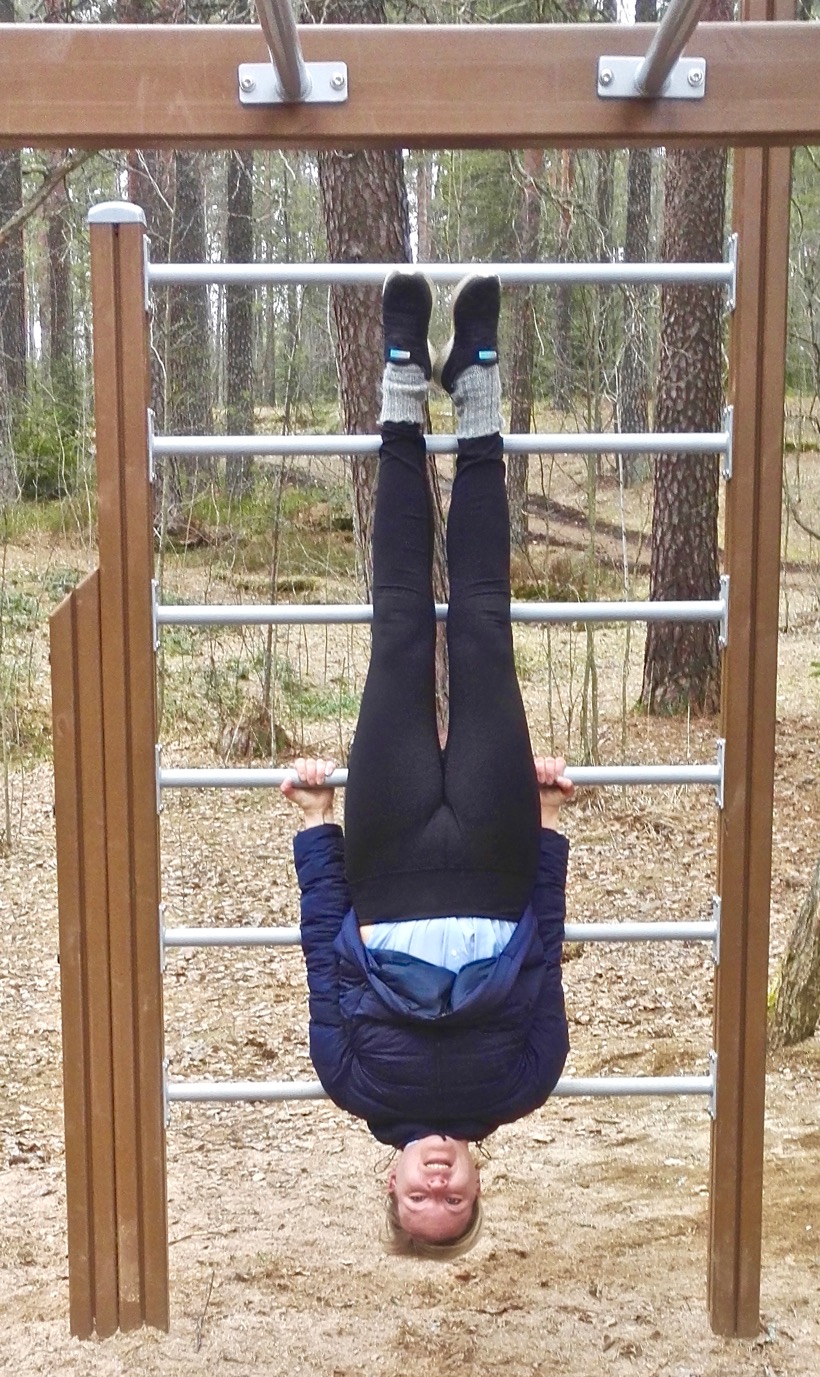
    • Hanging off a wall bar or a sealing bar (the metal bar connecting toilet cubicles is perfect: this used to be my go-to office pick me up, perfectly do-able in a suit and heels. Unfortunately I do not have any pictures.)
    • Reverse table top (also known as crab pose)
    • On a chair pressing down with your arms and lifting your bum and legs up (L-sit variation)
    • Handstand/cartwheel/any inversion

    The above might sound a bit crazy but hey, you can go to the gym and do dead lifts, or you can just practise lifting yourself. For the latter, do you really have any excuse?

    1. Approach your bedtime with the respect it deserves

    The other bookend of the day, bedtime, is just as important as the way you wake up. It really is worth the effort to put the phone away even 30 minutes before bedtime. An analogue alarm clock costs about 5 quid/euros (I just got a new one for myself) so you can even leave the phone to a different room all together. If feeling too fidgety for a silence straight away, try to old school before sleep activity of reading a book, a comic or a feature story in that free magazine you picked up three days ago.

    I find it easiest to ban all electronics from my bedroom at all times. That way I do not even have the opportunity to quickly check my phone the first thing in the morning or last thing in the evening. As I have to be physically up to get to it, having a good stretch or a cup of tea/coffee becomes just as feasible – and often preferred – action to take and in no time, a habit.

    What is your main daily routine that help you stay grounded and going every day?


  • The Difficulty of Being Honest with Yourself

    The Difficulty of Being Honest with Yourself

    One of the hardest things in this life is to be honest with yourself.

    The first reaction when I hear this phrase is to be in a state of complete denial. “I am realistic,” I’ll say to myself.

    “I know what I weigh, I am happy to list my development points if asked in a job interview and my insurance company knows I am a social smoker.“ And I suppose these statements are all true and admirable. No problems there.

    But I am talking about the deep shit, the stuff that is so deep under the surface, sometimes confusing, that we don’t even want to talk about it. Or in some cases, we talk about it all the time, overanalyse every detail over and and over again, convincing ourselves that we are ok with how things are.

    Yet, if we were to take a moment to be silent, uncomfortable feelings may surface. Feelings that are hard to grasp because they have been buried through days and months of a life bombarded by noise and constant action.

    These are the feelings that tell us the truth -the real truth- as to what is really going on deep down inside. Some call it intuition, some call it a gut feeling or inkling. I’m sure you know what I am talking about, because we all had moments when that feeling came so strong we could not ignore it. And whether you listened to that gut instinct or not, you knew deep down what the right thing in that situation would have been.

    But why is it that we often find it so hard to acknowledge what our mind and body knows all along?

    I am convinced that in most cases it is because of fear.

    Fear of having to walk away from situations and people we have become attached to, even though they are less than ideal.

    Fear of what other people might think if we go with our gut feeling.

    Fear because we cannot rationalise our intuition and it can often go against what would make sense rationally.

    Fear of the unknown and the anxiety of making the wrong move, regardless of what everything in our gut tells us otherwise.

    Fear for making a truly honest assessment of where are at.

    So how do we know it is time to take a moment and have a long, hard, good look inside? How do we recognise that something inside of us is trying to send us a message?

    It often starts with that quiet inner voice that something is off. It can be very hard to pinpoint what that “something” is, especially if everything seems to be just fine on the surface. Odd feelings can come and go, but if these feelings keep coming back – it is worth to take a pause and check in.

    The truth is not out there. It is inside. It is a long and difficult road to understand ourselves, but remember that the truth is alive and living in us. When we slowly begin to understand and connect to our inner truth, it can take some time to get comfortable with the feelings and emotions that comes with it. But there is no reason to fear this. The key is to take all the time that is needed. Days, weeks, months, sometimes years. It might feel overwhelming (again) but celebrate this journey and continue on making time for these moments to yourself on a regular basis, to check in and evaluate.

    Journal, reflect, whatever is needed. Dig deep for the honest connection with yourself.

    And remember- your truth is yours, and yours only.

    The first version of this text is published on Happy Girl Yoga.